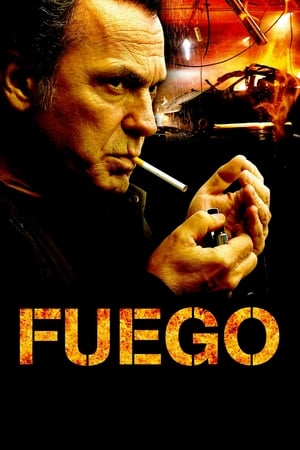
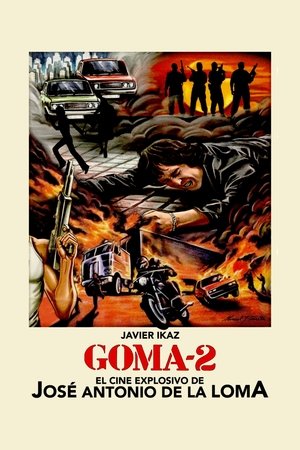
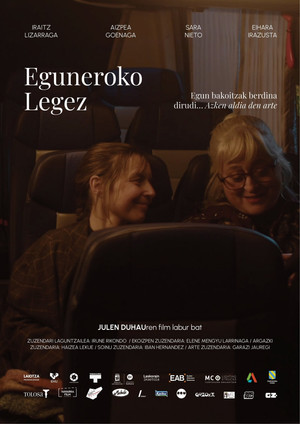
It's 8 AM in a summer morning from the 70's. Jon, an ETA member, is being chased by the police in the Old Town of San Sebastian. While he runs, he revises his whole life.
The story of two men on different sides of a prison riot -- the inmate leading the rebellion and the young guard trapped in the revolt, who poses as a prisoner in a desperate attempt to survive the ordeal.
Amaia has just become a mother, and the challenge is even more significant than she imagined. So when her partner has to leave for several weeks because of his job, she decides to spend time with her parents in a lovely coastal village in the Basque Country and hopefully share the responsibility of looking after her baby. However, she forgot that even when one becomes a parent, one never stops being a daughter.
A trigger-happy Nationalist fears retribution from the son of a man he executed. To mollify the boy's anger, he takes a drastic step: he keeps constant watch over the fig tree the boy has planted at his father's gravesite. As the years pass, the man's lonely vigil makes him a tourist attraction, much to the chagrin of his former colleagues.
Jone is a sixteen year old girl that lives in Bilbao (Basque Country) in 2009. In her highschool you can feel the independentist environment, demonstrations, strikes... are usuals between the students organizations. In this moment her dad starts to work int the Basque Government, between other things he has to go with body guards. This situation will change Jones life and she will have to learn to live between two worlds that she doesn't understand yet, and to understand that not everything is black or white.
Ion is a seemingly normal guy whose life goes by without a hitch. A phone call; a meeting with a friend; small, unimportant everyday situations. One day he gets into a car with two other people. They cross the border between Spain and France. The next morning, their lives will change forever.
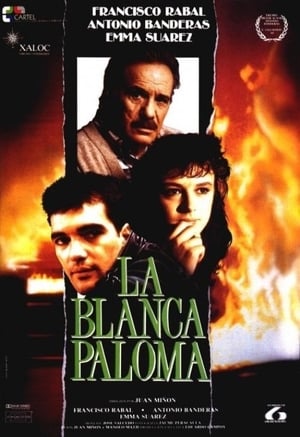
Rocío, is in love with Mario, a free rider with a lot of face that, to top it all, is partner of the business of her father, Domingo with whom she maintains incestuous relations. When Domingo passes away, both Mario and Rocío's mother have to put to the front of the business, finishing with the inheritance that could receive Rocío. In the midst of her frustration, a young business worker, secretly in love with Rocío, will try to have the legacy of her father end up in the hands of his rightful heiress.
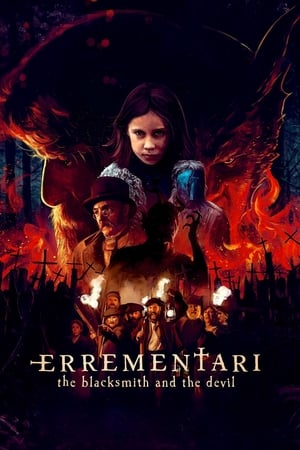
Basque Country, Spain, 1843. A police constable arrives at a small village in Álava to investigate a mysterious blacksmith who lives alone deep in the woods.
Spain, 1973. Dictator Francisco Franco has ruled the country since 1939 with an iron fist; but he is now a very old and sick man. The future of the weakened regime is in danger. Admiral Carrero Blanco is his natural successor. The Basque terrorist gang ETA decides that he must die to prevent the dictatorship from continuing.
Two journalists investigate the criminal activities of the GAL (Grupos Antiterroristas de Liberación), a secret terrorist organization founded in the eighties and financed by leading figures in the Spanish government and security forces to hunt down and exterminate both members and collaborators of the terrorist gang ETA.
Spain, Basque Country, 17th century. At night and through the mountains, Kattalin escapes from her farmhouse and, while wandering through the deep forest, she senses a presence that stalks her.
Xabi, a troubled boy, meets Iñaki, a member of the terrorist gang ETA who becomes his mentor and ideological inspiration. Some time later, Xabi is arrested for throwing a Molotov cocktail and confined in a juvenile detention center, where he meets Joel, a Mexican, and Driss, a Moroccan, with whom he manages to flee and reach Madrid with the purpose of finding Iñaki and joining the gang.
Election night. Aimar, leader of the left-wing Basque nationalist movement, returns home more tired than ever. Itziar awaits him, exhausted. At the entrance, the remnants of a protest by the radical youth of their own party. Aimar has to make a decision: Does he want to continue dedicating his life to the nationalist cause, even in the worst of times?
In the year 2000, Maixabel Lasa’s husband, Juan Maria Jauregi, was killed by ETA. Eleven years later, she receives an incredible request: one of the men who killed Juan wants to meet with her in the Nanclares de la Oca prison in Araba (Spain), where he is serving his sentence after breaking ties with the terrorist group. Despite her reservations and her immense pain, Maixabel Lasa agrees to meet face to face with those who ended the life of the person who had been her companion since she was 16 years old. ‘Everyone deserves a second chance’, she said, when asked why she was willing to confront the man who killed her husband.
Bilbao, Basque Country, 2001: a ruthless terrorist attack shatters the family of police officer Carlos Martínez. Barcelona, 2013: Carlos leaves Mariusz, a Polish immigrant, in charge of his daughter and, offering vague excuses, returns to the Basque Country and rents a house in Lekeitio, a small village by the sea.
Ainhoa's career as a pianist is put on hold when she's knocked down in the center of Barcelona. Her love life isn't exactly at its best either. Shortly before the accident she met Imanol, but had been incapable of sharing her life with him due to an inability to show her feelings. The origins of her fears lie in the ETA attack she witnessed at the age of 15.
Arián, a young Basque girl, idealistic but naive, joins a ruthless terrorist gang and, hoping to prove her commitment, volunteers to participate in the kidnapping of the daughter of an important businessman.
An act of cowardice influences the lives of two Basque families over three generations.
Basque Country, Spain, 2011. A young woman who intends to flee to France due to the turbulent political situation stops in Zubieta, a border town where ancient myths and modern problems converge.
At the death of his father, Paulo, the youngest son, will have to be in charge of his mentally handicapped brother Daniel. Based on the novel by Bernardo Atxaga.