Classics on a Summer's Evening is an outdoor concert for an enormous audience which was staged in an architecturally striking public square in Dresden in July 1999. It features the most glamorous young husband and wife currently active on the international operatic scene, soprano Angela Gheorghiu and tenor Roberto Alagna. Along with these fine performances comes Giuseppe Sinopoli--before his untimely death at age 54--who was considered one of Europe's finest opera conductors, and, in the Dresden orchestra and chorus, performers who match his creative energy.
Tan Dun portrays the Venetian explorer's travels to the Far East as a journey of both inner and physical discovery, a voyage depicting spiritual experiences as well as a geographical expedition. Pierre Audi's mythical staging and Jean Kalman's fabulous set design complement the composer's own musical direction, forging the dazzlingly versatile soloists, the Netherlands Chamber Orchestra and Cappella Amsterdam to a stunning symbiosis of elements across time and space, a true testimony to cultures intertwined in globalization.
Opera at La Scala Milan
Arabella, Op. 79, is a lyric comedy or opera in three acts by Richard Strauss to a German libretto by Hugo von Hofmannsthal, their sixth and last operatic collaboration.
This was Domingo's last set of performances as Otello in La Scala. In spite of his relatively advanced age, he is still in excellent form, both vocally and in terms of stage presence. Nucci is also his usual self, delivering a performance of very high standard. Barbara Frittoli is an excellent Desdemona, in good voice and gives a very moving performance. Muti conducts with great emotion and tight accuracy, conveying the full orchestral drama of the score.
In the mid-20th century, in Fucecchio, near Florence, Buoso Donati, an elderly collector and wealthy antique dealer, has just passed away. He lies in his bed, surrounded by relatives feigning grief. They are all worried, as the deceased has bequeathed his entire fortune to a monastery. They search frantically for the will. The young Riniccio, Donati’s nephew, finds it but agrees to show it to the family only if they promise to let him marry Lauretta, the daughter of Gianni Schicchi, a local figure of dubious reputation. Everyone accepts the condition and discovers to their horror that the rumour was true: the monks are set to inherit the fortune. Riniccio suggests calling on Schicchi for help, much to the family’s disgust. Summoned, Riniccio arrives at the house accompanied by his daughter. He proposes keeping the death a secret, taking his place, and instructing a doctor and a notary to alter ‘his’ testamentary dispositions. But has the hunter become the hunted? Not so sure...
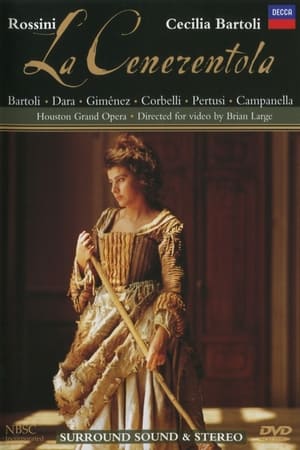
In late 18th-century Italy, in the mansion of Don Magnifico, the young and pretty Angelina works as a maid. Teased by her two frivolous half-sisters, Clorinda and Tisby, Angelina believes she is in love with a young valet and goes to the ball. Dressed in her finest finery, she meets the man who is in fact the Prince and flees from him after giving him a bracelet that will allow him to recognise her a little later. The masks come off, and kindness and love triumph! ‘La Cenerentola’ is the last opera buffa composed by Gioachino Rossini for an Italian audience. A dramma giocoso in two acts, with a libretto by Jacopo Ferretti, freely adapted from Charles Perrault’s fairy tale ‘Cinderella’ (1697), omitting the magic in favour of a realism tinged with humour and social criticism. Premiered for the Rome Carnival at the Teatro Valle in Rome on 28 January 1817. Recorded live at Glyndebourne Opera, Lewes, East Sussex, on 2 and 4 June 2005.
The writer Dario Fo applies his inventive genius to Rossini's comic opera in its premiere DVD release. Recorded in 2005 under the musical direction of Maurizio Barbacini, Fo's production brings fresh vitality and colour to the story of Lisetta, and of her father Don Pomponio's increasingly ridiculous attempts to find a husband for her through an advertisement in the newspaper LA GAZZETTA. Filmed using high definition cameras with multitrack sound.
This filmed version of Strauss' shocker features Teresa Stratas as opera's most depraved teenager, and she's as perfect a Salome as one would ever hope to see or hear. Stratas inhabits the role, exploring the character's sensuousness as she vainly woos Jochanaan, her venomous hatred when she's rejected, the crazed look in her eyes when she demands his head--on a silver platter, no less. Such complete identification with a role, especially of a character so malignant helps make this 1974 Salome stand out among the many fine DVDs of the opera.
A lonely mother and her son go to the opera where a performance of Cherubini’s opera Medea is given. It is the mother’s birthday and she wanted to surprise her son by inviting him to the opera. But, the son’s plan were different and he is quite upset about it. His mother tries to break the silent barrier behind which he hides. A semblance of discussion begins, not without humour. Tension is present but, as the performance goes on, both find themselves astounded, captured, alone in the opera house.
In Rigoletto, the deformed figure of the hunchbacked jester at the Mantuan court acts as a foil to his cynical and powerful master, an unscrupulous philanderer contrasted with his cruel and unforgiving fool. Rigoletto encourages and welcomes the Duke's conquests, pitilessly mocking his victims until he discovers that the Duke has abducted the one person he genuinely loves, his own daughter. As a result, the character of the court jester is transformed into a tragic figure who, in spite of his evident immorality and malice, allows us to sense the devotion he feels for his daughter and his horror at being destroyed by the same despotic world as that which he himself has helped to create.
When Strauss and Hofmannsthal wrote «Der Rosenkavalier» – setting it in an imaginary Rococo Vienna and yet closely linked to the decadent fin de siècle – they created a profound social comedy. It is not without melancholy that the Marschallin lets her young lover Octavian go when he falls head over heels with Sophie, who hails from Faninal’s bourgeois household. As voluptuous as Strauss' score is, it contains tender moments of dream and melancholy. Director Lydia Steier stages Strauss’ opera according to an aesthetic concept by Austrian artist Gottfried Helnwein. Diana Damrau sings the Marschallin. Joana Mallwitz, chief conductor at the Konzerthaus Berlin, conducts the Orchester der Oper Zürich.
Diana Damrau and Vittorio Grigolo are opera’s classic lovers in Gounod’s lush Shakespeare adaptation. Director Bartlett Sher’s “brilliant and inspired new production … is a revelation” (Huffington Post), and has already won acclaim for its vivid 18th-century milieu and stunning costumes during runs at Salzburg and La Scala. Emmanuel Villaume conducts the sumptuous score.
The legendary Plácido Domingo brings another new baritone role to the Met under the baton of his longtime collaborator James Levine. Liudmyla Monastyrska is Abigaille, the warrior woman determined to rule empires, and Jamie Barton is the heroic Fenena. Dmitri Belosselskiy is the stentorian voice of the oppressed Hebrew people.
The water fairy Rusalka falls in love with an earthly prince. In vain, Father Aquarius warns her. Her sincere feelings are met with human treachery...
Franco Zeffirelli's magnificient staging of Puccini's final opera - a fairy tale set in a mythical China - is one of the most popular in the Met repertory. In this Live in HD production, Maria Guleghina takes on the title role and Marcello Giordani is Calaf, the unknown prince. Marina Poplavskaya and Samuel Ramey co-star, and Andris Nelsons conducts in his Met debut.
Live broadcast of the opera performance held on November 10, 2012 at the Opéra national de Lorraine in Nancy, performed by five world-class countertenors.
Semyon Bychkov conducts a cast of young, up-and-coming talent including American soprano Corinne Winters in a new production of Mozart’s opera on the nature of love.
By the year 2056, an epidemic of organ failures has devastated the planet. The megacorporation GeneCo provides organ transplants on a payment plan — and those unable to fulfill their plans have their organs repossessed. In the midst of this, a sickly teenager discovers a shocking secret about herself, her father, and their connection to GeneCo.
Ariadna