White’s camera offers several 360-degree pans of views of the fairground, then amazes by tilting up and down the Eiffel Tower, and concludes with a stunning tracking shot to the highest point above Paris. Exhibitors freely grouped films into nascent narratives such as those displayed here. - Bruce Posner
An urban train link, the RER B, crosses Paris and its outskirts from north to south. A journey within indistinct spaces known as inner cities and suburbs. Several portraits, all individual pieces that form a whole. We.
Bordeaux-Paris was the best bike race you’ve never heard of: a midnight start, 550km-long, and ridden behind motorised ‘dernys’, with winners including Jacques Anquetil and Tom Simpson. More than thirty years since Bordeaux-Paris was last raced, pro cyclists Mitch Docker and Sam Bewley are aiming to recreate the infamous 1965 edition. How will they fare at the ‘Derby of the Road’?
Journey to Paris, the City of Light. Marvel at the panorama from the top of the Eiffel Tower and the Arc de Triomphe. Walk down the Champs-Élysées from l'Etoile to Place de la Concorde. Go inside Maxim's and Tour d'Argent to experience an elegant French meal, then pause at Dux magots for a cafe au lait. Stroll along the Rue du Faubourg St. Honore and window shop at Dior and Lanvin. Enter the Louvre to view Winged VIctory, Venus de Milo and Mona Lisa. Glide down the Seine on a bateau mouche, past Notre Dame and the Ile St. Louis. Zoom through traffic in a Parisian taxi and ride the Metro. Climb to Montmartre, Sacre Coeur and Place du Tertre. Take a side trip to Versailles and be dazzled by the Hall of Mirrors.
For the first time in the history of the Games, the opening ceremonies of the Olympic Games and Paralympic Games will take place - just a few weeks apart - outside the stadium, in the heart of Paris. On 28 August 2024, the bottom of the Champs-Elysées and Place de la Concorde will be transformed into the impressive backdrop for a ceremony that will feature a parade of 4,400 athletes from approximately 184 Paralympic delegations from around the world.
On Sunday 8 September at Stade de France, the Closing Ceremony of the Paris 2024 Paralympic Games officially drew 11 days of competition to a close. Called Paris est une fête, the ceremony, directed by Thomas Jolly and designed by Romain Pissenem, paid tribute to the 4,400 athletes who took part. But the ceremony also highlighted the history of electronic music and of Paris as a city of celebration and culture.
The amazing and epic story of how the Paris Opera House, the Palais Garnier, was built from 1852 to 1870, thanks to the decisive impulse of the French Emperor Napoleon III; a story that is also that of the birth of a golden age for orchestral music, opera and ballet; of the rise of the urban bourgeoisie turned social elite; and of a certain mysterious inhabitant of the darkest corners of a legendary place.
In May of 1982 Julio Cortázar, the Argentinean writer and his companion in life, Carol Dunlop set out in their VW bus on a journey along the highway from Paris to Marseille that, for each of them, was to be their final one. Twenty-five years later, Océane Madelaine and Jocelyn Bonnerave set out to undertake the journey again.
George Stevens's remarkable film is acclaimed by historians as the most important colour footage taken during the war. Milestones covered include the liberation of Paris, the link-up between the Russian and American armies on the River Elbe and the Allied capture of the Dachau concentration camp.
Artfully erotic nudity with plush, glamorous décor and sensual, atmospheric lighting: The Crazy Horse, in the French capital’s well-heeled eighth district, has been delighting audiences for 70 years with its special brand of classy Parisian cabaret.
While Paris, the City of Lights, shines brightly, hidden in its shadows are fascinating installations, put in place nearly two centuries ago: the sewers. Even today, this 2,600-kilometer-long labyrinth of streets and infrastructure ensures the sanitation of the entire capital. In 1854, during Haussmann's grand urban renewal projects in Paris, the French engineer Eugène Belgrand undertook one of the century's largest construction projects: the renovation of the Paris sewers. His main innovation: an ingenious dual network that simultaneously treats wastewater and delivers drinking water to Parisians.
TGV, 30 ans de vitesse
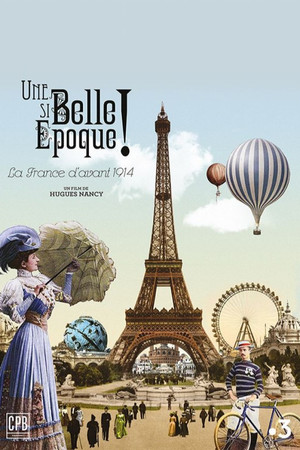
The Bokelberg photographic collection brings to life the Paris of the Belle Époque (1871-1914), an exhibition of workshops and stores with extremely beautiful shop windows before which the owners and their employees proudly pose, hiding behind their eyes the secret history of a great era.
The French female pioneer of immersion journalism, Maryse Choisy, who infiltrated in 1928 the prostitution underworld of Paris. Posing as a chambermaid, a lesbian bar dancer and more, she wrote a very successful and scandalous book about that avant-garde experience, and changed her mind about this world and these women's difficult condition.
Three children living in a displacement camp in northern Uganda compete in their country's national music and dance festival.
In the heart of Paris, an entire palace has disappeared. It was the very first residence of the kings of France. Long before Versailles, long before the Louvre, the Palais de la Cité stood on the most prestigious island in Paris, the historic cradle of France, facing Notre-Dame. So majestic in the Middle Ages, this palace has become a ghost of history. Over the centuries, this architectural masterpiece has almost completely disappeared. A trio of experts will resurrect it in 3D. Using science and unprecedented excavations, they will track down the pieces of the puzzle to reconstruct it at its peak in the 14th century, and bring back to life those who inhabited it. From the Romans to the Vikings, from Saint Louis to the cursed kings, all have left clues of this 'Versailles of the Middle Ages'.
The story of Zineb El Rhazoui, a young Moroccan woman who, in the wake of the Charlie Hebdo attack, finds her life radically transformed : from a censored journalist in Morocco she becomes the most protected woman of France.
Inspired by an exclusive interview and performance footage of Chavela Vargas shot in 1991 and guided by her unique voice, the film weaves an arresting portrait of a woman who dared to dress, speak, sing, and dream her unique life into being.
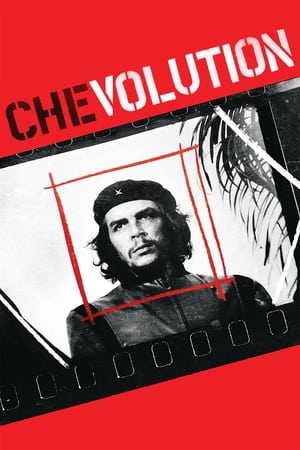
Examines the history and legacy of the photo Guerrillero Heroico taken by famous Cuban photographer Alberto Díaz Gutiérrez. This image has thrived for the decades since Che Guevara's death and has evolved into an iconic image, which represents a multitude of ideals. The documentary film explores the story of how the photo came to be, its adoption of multiple interpretations and meanings, as well as the commercialization of the image of Ernesto "Che" Guevara.
From May 10, 1940, France is living one of the worst tragedies of it history. In a few weeks, the country folds, and then collapsed in facing the attack of the Nazi Germany. On June 1940, each day is a tragedy. For the first time, thanks to historic revelations, and to numerous never seen before images and documents and reenacted situations of the time, this film recounts the incredible stories of those men and women trapped in the torment of this great chaos.