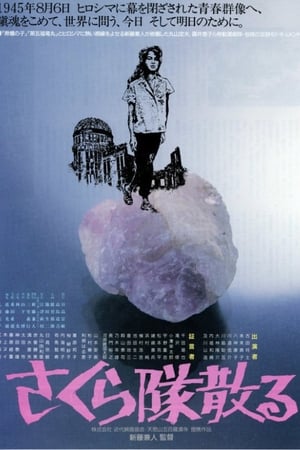
A documentary about the lives of actors in the Sakura-tai theatrical troupe, which had arrived in the island of Hiroshima to begin preparations for the staging of a play just before the atomic bombing.
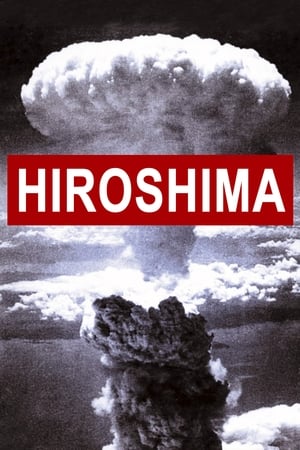
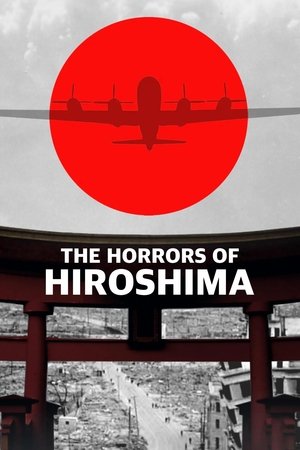
On August 6 1945 The Us Dropped An Atomic Bomb On Hiroshima Aiming To Force Japans Surrender In WWII The Explosion Killed Over 70000 Instantly With Tens Of Thousands More Dying From Burns Radiation And Injuries The City Was Leveled Survivors Faced Lifelong Trauma Illness And Stigma As The World Confronted Nuclear Horror For The First Time
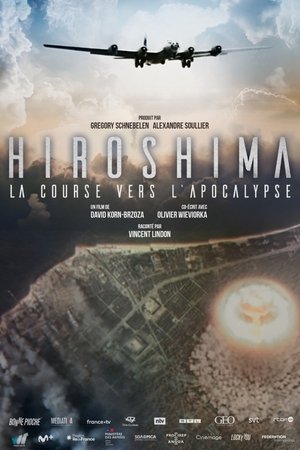
The documentary recounts the world's first nuclear attack and examines the alarming repercussions. Covering a three-week period from the Trinity test to the atomic bombing of Hiroshima, the program chronicles America's political gamble and the planning for the momentous event. Archival film, dramatizations, and special effects feature what occurred aboard the Enola Gay (the aircraft that dropped the bomb) and inside the exploding bomb.
Brand new documentary marking the 70th anniversary of the Hiroshima and Nagasaki bombings which ended WWII and began the nuclear age. Features interviews with survivors from both sides.
Combining personal accounts with archive footage, this film features the voices of some of the only people left on earth to have survived a nuclear bomb.
Hiroshima: The Race Toward the Apocalypse
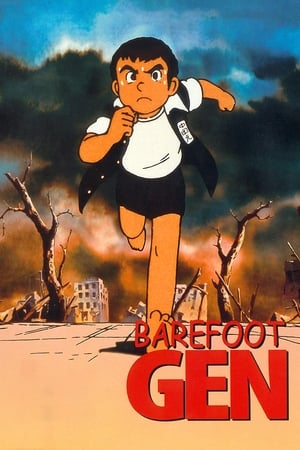
Three years after the Hiroshima bombing, a teenager helps a group of orphans to survive and find their new life.
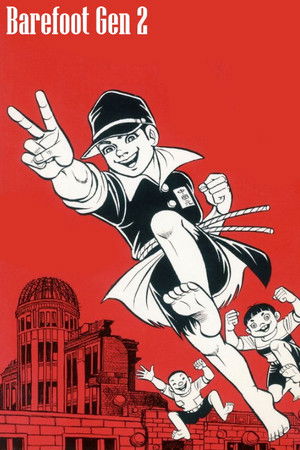
A story about the effect of the atomic bombing of Hiroshima on a boy's life and the lives of the Japanese people.
An approximation to the atomic bombing of Hiroshima by experimental animation artist José Castillo.
Experimental dramadoc about high-functioning alcoholics and problem drinking in the workplace. Based on the testimony of real people, with actors playing out their stories and the whole film mimicking the texture of a witty and gritty observational documentary.
The “Journal Annales” consists of almost 2.000 hours of video footage collected by filmmaker Lionel Soukaz since 1991. For “Carottage”, the idea was to take a random sample from this vast volume, like a geological core sample. The result is a condensed history of political struggles and radical cultural experimentation spanning two decades.
Following Professor Lee White, the Environment Minister of Gabon, and President Ali Bongo as they act to save one of Earth's most vital natural habitats in the face of cartels and corruption.
Six runners face the Superior 100, a 30-hour, 100-mile trail race. How do they prepare and how will it change them?
Documentary commemorating the 40th anniversary of the 'Carry On' comedy film series. Archive clips and out-takes are mixed with interviews with the cast.
Le Pen, l’éternel combat
Churchill, a name typically associated with braveness and altruism. Recently found evidence from Soviet and British sources however brings up questions about Churchill's doings in the conferences of Tehran, Yalta and Potsdam. Why did he agree to give Stalin large parts of Poland? The story of two world leaders in times of war - it is also the story of Poland.
Morning After the Deluge is a large-scale, single-projection video installation, preferably presented in a dedicated room where the projected image is directed onto a free-standing screen. The work features two pieces of real-time footage that the artist filmed in Cape Cod, Massachusetts – one a sunset over the Atlantic Ocean and the other a sunrise on Cape Cod Bay – that are merged together and presented on a continual loop. As the sun slowly disappears into the ocean on one side, it rises out of the water on the other. In this new arrangement, the usual figure-ground relationship is upended: the sun becomes a fixed point at the centre of the image while the horizon line becomes unfixed, slowly wandering across the frame from top to bottom.
Manolito Espinberg: une vie de cinéma
A heady, energised mash-up of animation, unseen archive footage and interviews, Rebel Dykes provides an intimate insight into the politically charged, artistically radical anarchist subculture in 1980s London, and the individuals who helped shape and change their world. Bringing together BDSM nightclubs, inclusive, sex-positive feminism, DIY zine culture, post-punk musicians and artists, squatters, activists and sex workers, these rebel dykes went out onto the streets to make their voices heard. [Feature length version of 2016 short of the same name.]
When Kennedy announced in 1961 that he wanted to take humans to the moon within a decade, Charles M. Duke was skeptical. Almost 11 years later, however, Charles M. Duke was standing on the moon himself. He gave Neil Armstrong the go-ahead for the landing on Apollo 11. Because he contracted rubella, the Apollo 13 crew had to be changed. In 1972, he landed with Apollo 16 and looked down on Earth from the moon himself.