Comedian Wim Helsen apologizes for the violence, religious extremism and lousy economy plaguing Europe, then offers a happy panacea for all of it.
Rayen Panday: Fenomeen
Registration of the sixt theatre program by the Dutch comedian Theo Maassen.
In his third theatre program the Dutch comedian Hans Teeuwen plays with empty wine bottles, little girls and himself. Poetic, absurd, false and genuine.
Registration of the fourth solo program by the Dutch comedian Hans Sibbel, in which the comedian takes a look at the evolution.
Registration of the theatreprogram by the Dutch comedian Lenette van Dongen. Armed with the complete DVD box of dogwhisperer Cesar Milan and all Martin Gaus-books, Van Dongen starts raising a young puppy. What this world needs is a calm, confident leader. It's only a matter of time before a well-trained rescuer walks by her side. Until one day the dog trainer gets sick and everything turns out differently….
Back in 2003, Alex Agnew was the first Belgian to win the prestigious 'Leids Cabaret Festival' in The Netherlands. He was the winner in both categories: Jury and public. Alex is a mixture of an English father, Belgian mother, an overdoses (action) movies, superheroes, comic books and a lot of music. No quiet, sophisticated humour, but proud to be loud! Rock'n'Roll comedy!
Registration of the eight theatre program by the Dutch comedian Richard Groenendijk.
Maassen won two of the biggest comedy contests in the Netherlands in 1990, the Groninger Studenten Cabaret Festival(GSCF), and Cameretten. The GSCF jury was not pleased with the quality of the contestants that year, and gave Maassen the first prize, remarking he was the best of the year, but still not very good. In the following years, however, Maassen fame grew steadily, especially amongst students. Maassens style was based on stand-up comedy: Alone on stage, telling jokes and stories to amuse the public, without any musical support (a thing common for most Dutch comedians up to that point).
Tineke Schouten: Top Tien 2
Maassen won two of the biggest comedy contests in the Netherlands in 1990, the Groninger Studenten Cabaret Festival(GSCF), and Cameretten. The GSCF jury was not pleased with the quality of the contestants that year, and gave Maassen the first prize, remarking he was the best of the year, but still not very good. In the following years, however, Maassen fame grew steadily, especially amongst students. Maassens style was based on stand-up comedy: Alone on stage, telling jokes and stories to amuse the public, without any musical support (a thing common for most Dutch comedians up to that point). Since 2000, Maassens shows are shown on Dutch national television, making him more and more a household name.
Mind you is the fourth theater of the Dutch comedian Hans Teeuwen. He performed the show in 2001. The last show was filmed in 2002 and aired on television, the same year that the show on CD and DVD published. It's Teeuwen's most famous and most frequently quoted show. He takes everything on the heel, including racism, blacks, world religions, AIDS patients, women, Jostiband and the Queen of the Netherlands.
Registration of the first theatre program by the Dutch comedian Theo Maassen.
Comedian Patrick Laureij grew up in Rotterdam-Zuid and uses his life experience to talk about underage drinking, kickboxing, and playgroups.
Registration of the theatre program by the Dutch comedian Herman Finkers. After 7 years of silence Herman Finkers returns back on stage to merge humor and seriousness and shows a disease can actually change a person.
Registration of the second theatre program by the Dutch comedian Theo Maassen.
Registration of the fourth theatre program by the Dutch comedian Theo Maassen.
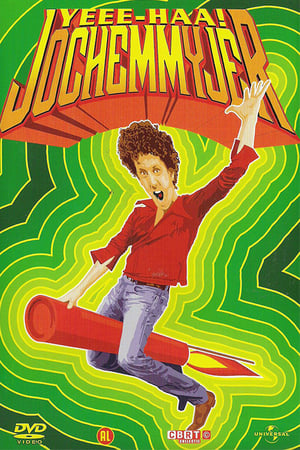
Jochem's decor consists of Trivial Pursuit pieces, each of which represents a dream. He talks about his school trip, his girlfriends, and family members, each of whom he gives an absurd characteristic. A recurring theme throughout his story is his cheerfulness and positivity. He calls this the Yee-Haa! feeling.
Destressing? Do that at home, will you! In 'Adéhadé', everything goes in overdrive, with many Dutch celebrity impressions.
The show is mainly about his various friends in Leiden and the people who share this city with him. He talks about his neighbors Halfzeven, Halfacht, and Halfnegen, jumps around to waltz music, does impressions of Dutch celebrities while standing on the vibrating belt, and is joined on either side by holograms of himself dancing along with him.