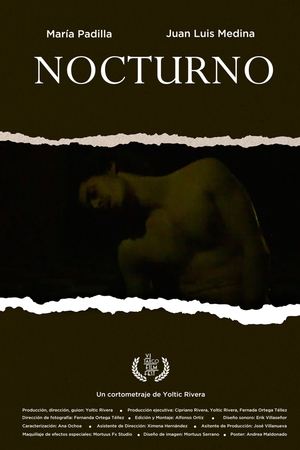
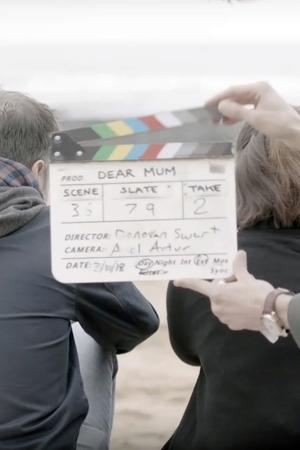
A first feature based on sexual events. An actress undertakes her desire of directing her first movie, without a budget or any production company funding her project. She gathers a group of professional actors and actresses, and proposes a project based on a very particular experience: stepping on their fears through a metaphorical 'leap of faith'. As the project advances, individual conflicts will arise affecting the shoot, making the movie crew wonder whether or not they should go on. Will they take the leap of faith with all its consequences?
Industrialization brings progress, but also harmful influences on the environment. Warning of the dangers of waste materials dumped into the air and the waters.
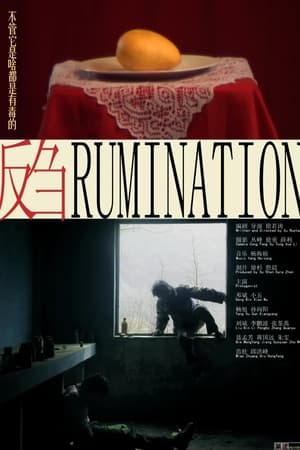
A surreal, moody short about the fetishisation of automobiles and auto accidents.
The second part: Brakhage’s layering of images spends less time with images of war, and begins filtering in scenes of Vienna and his home in Colorado. He sets up a comparison between “Kubelka’s Vienna” and his own.
This film describes a psychological state "kin to moonstruck, its images emblems (not quite symbols) of suspension-of-self within consciousness and then that feeling of falling away from conscious thought. The film can only be said to describe or be emblematic of this state because I cannot imagine symbolizing or otherwise representing an equivalent of thoughtlessness itself. Thus the actors in the film, Jane Brakhage, Tom and Gloria Bartek, Williams Burroughs, Allen Ginsberg, Peter Olovsky and Phillip Whalen are figments of this 'Thought-Fallen Process', as are their images in the film to find themselves being photographed."
A woman returning home falls asleep and has vivid dreams that may or may not be happening in reality. Through repetitive images and complete mismatching of the objective view of time and space, her dark inner desires play out on-screen.
In 1948, French singer Charles Aznavour (1924-2018) receives a Paillard Bolex, his first camera. Until 1982, he will shoot hours of footage, his filmed diary. Wherever he goes, he carries his camera with him. He films his life and lives as he films: places, moments, friends, loves, misfortunes.
A teenager decides to shut himself off from the world around him after receiving bad news.
Rather than writing a simple letter to explain his absence from the press conference for his latest Cannes entry, "Goodbye to Language," at the Cannes Film Festival, instead, legendary filmmaker Jean-Luc Godard created a video "Letter in motion to (Cannes president) Gilles Jacob and (artistic director) Thierry Fremaux." The video intercuts from Godard speaking cryptically about his "path" to key scenes from Godard classics such as "Alphaville" and "King Lear" with Burgess Meredith and Molly Ringwald, and quotes poet Jacques Prevert and philosopher Hannah Arendt.
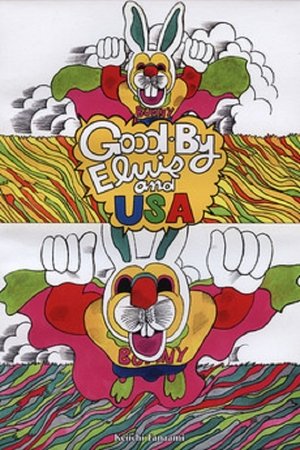
A trippy pop-art collage of phallic objects, naked women and American icons, most notably Elvis Presley.
First part of the collaborative project "Brise-Glace" showing the diverse travels on the icebreaker "Frej". Directed by Jean Rouch.
How many movies have you seen where at the end the main character wakes up, causing he and the audience to simultaneously realize that everything they witnessed beforehand was "just a dream?" This film takes that principal but instead of deceiving, the story invites you to watch the main characters dream away. As a result, "True Dreams" takes the dream sequence to a whole new level: it lets its audience in on the joke, while they watch the two main characters run around unaware of the reality/fantasy of their surroundings. This film can be viewed via Vimeo at https://vimeo.com/132642294 (password: truedreams)
It started with filming the tree. Something was released in that manner of filming seemingly farthest removed from the procedure of the early films. I first thought a simple ordering of this rich material might be enough, something related to BARN RUSHES [...] But the film only came into its form-life with the idea of linking this deep-rooted and far-outreaching tree material with that film on paranoia that had fascinated me for many years. –L. G.
"With characteristic wit and rigor, experimental filmmaker Larry Gottheim here applies his impressionistic editing style to footage collected during his travels in the Dominican Republic. Gottheim’s formal emphasis on repetition and fissures between sound and image resonates here as a mode of sociological reflection (with the fragmentary montage mirroring elements of ritual while also destabilizing the ethnographic gaze). A largely overlooked antecedent to the contemporary blending of avant-garde and ethnographic filmmaking, MACHETTE GILLETTE… MAMA still poses a potent challenge to documentary convention." - Max Goldberg
Glen doesn't dare tell his fiancée Barbara that he is a transvestite; in addition, Alan is undergoing medical treatment to become a woman named Anne; both stories are told by a psychiatrist.
CREMASTER 3 is set in New York City and narrates the construction of the Chrysler Building, which is in itself a character - host to inner, antagonistic forces at play for access to the process of (spiritual) transcendence. These factions find form in the struggle between Hiram Abiff or the Architect...
CREMASTER 4 adheres most closely to the project's biological model. This penultimate episode describes the system's onward rush toward descension despite its resistance to division. The logo for this chapter is the Manx triskelion - three identical armored legs revolving around a central axis. Set on the Isle of Man, the film absorbs the island's folklore...
An experimental ethnographic documentary that criticizes the colonizer view of anthropology.
La orilla que se Abisma is conceived as a journey, a trip along a river. Like rivers, like all journeys, the film has meanders, small riverbeds, detours and moments of rest.
Filmmakers use archival footage and animation to explore the culture surrounding nuclear weapons, the fascination they inspire and the perverse appeal they still exert.