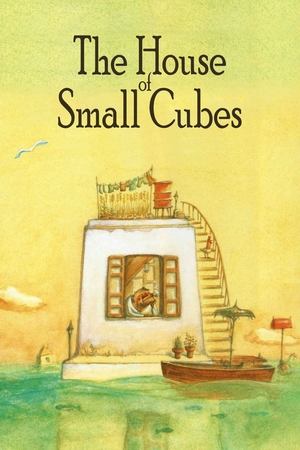
La Maison en Petits Cubes tells the story of a grandfather's memories as he adds more blocks to his house to stem the flooding waters.
Filmmakers use archival footage and animation to explore the culture surrounding nuclear weapons, the fascination they inspire and the perverse appeal they still exert.
Senescence
An anthology of one-minute films created by 51 international filmmakers on the theme of the death of cinema. Intended as an ode to 35mm, the film was screened one time only on a purpose-built 20x12 meter public cinema screen in the Port of Tallinn, Estonia, on 22 December 2011. A special projector was constructed for the event which allowed the actual filmstrip to be burnt at the same time as the film was shown.
Village, like a human being, is born out of love. Village, like a human being, is ruined, if left without love.
I turned my gaze to the various events in daily life and made this filmic diary in a manner as if confessing my feelings. Of course, since I was making the film, I wanted to depict these feelings and events with tricky techniques. I used various methods to shoot photographs of a relative's wedding, the landscape I see from window of my house, commemorative travel photographs and the like frame-by-frame.
A short movie about a guy living in his own world.
Creeping from the halls of the maze brain, corruption and terror is woven by devils born from the denied errors of mankind.
Inspired by the Greek myth of Prometheus, a Titan who created the first mortals from clay and stole fire from the gods, Prometheus' Garden immerses viewers in a cinematic universe unlike any other. The dark and magical images of this haunting film unfold in a dreamlike stream of consciousness revealing an unlikely cast of characters engaged in a violent struggle for survival.
A boom operator attempts to record the noise mushrooms make in this semi-experimental animation inspired by the world of sounds.
An animation mixing hand-drawn and cut-out techniques depicting the daily rituals of weekday morning that is occasionally interrupted by flights of fantasy delivered in stroboscopic flashes. Showing scenes of brushing teeth and face washing, Tanaami describes the film to be like a self-portrait on his favorite day of the week.
Mizuki Kiyama's short animation utilizes a paint on glass technique to render a young girl's visit to a neighborhood sento (bath house) with her mother with dazzling sensuous wonder. Evoking childish fascination at daily rituals, this quotidian act amidst feminine intimacy becomes a space of otherworldly fantasy.
A space occupies it, awaiting to be unlocked by a freeing action or notion. What lies ahead is its determination.
"Beyond Noh" rhythmically animates 3,475 individual masks from all over the world, beginning with the distinctive masks of the Japanese Noh theater and continuing on a cultural journey through ritual, utility, deviance, and politics.
A tilted figure, consisting largely of right angles at the beginning, grows by accretion, with the addition of short straight lines and curves which sprout from the existing design. The figure vanishes and the process begins again with a new pattern, each cycle lasting one or two seconds. The complete figures are drawn in a vaguely Art Deco style and could be said to resemble any number of things, an ear, a harp, panpipes, a grand piano with trombones, and so on, only highly stylized. The tone is playful and hypnotic.
Seemingly at random, the wings and other bits of moths and insects move rapidly across the screen. Most are brown or sepia; up close, we can see patterns within wings, similar to the veins in a leaf. Sometimes the images look like paper cutouts, like Matisse. Green objects occasionally appear. Most wings are translucent. The technique makes them appear to be stuck directly to the film.
After the title, a white screen gives way to a series of frames suggestive of abstract art, usually with one or two colors dominating and rapid change in the images. Two figures emerge from this jungle of color: the first, a shirtless man, appears twice, coming into focus, then disappearing behind the bursts and patterns of color, then reappearing; the second figure appears later, in the right foreground. This figure suggests someone older, someone of substance. The myth? Preserved by the Academy Film Archive in 2012.
A visual representation, in four parts, of one man's internalization of "The Divine Comedy." Hell is a series of multicolored brush strokes against a white background; the speed of the changing images varies. "Hell Spit Flexion," or springing out of Hell, is on smaller film stock, taking the center of the frame. Montages of color move rapidly with a star and the edge of a lighted moon briefly visible. Purgation is back to full frame; blurs of color occasionally slow down then freeze. From time to time, an image, such as a window or a face, is distinguishable for a moment. In "existence is song," colors swirl then flash in and out of view. Behind the vivid colors are momentary glimpses of volcanic activity.
Hans Richter, noted for his abstract shorts, has everyday objects rebelling against their daily routine.
Rainbow Dance is a 1936 British animated film released by the GPO Film Unit. This is Lye's second film. It uses the Gasparcolor process.