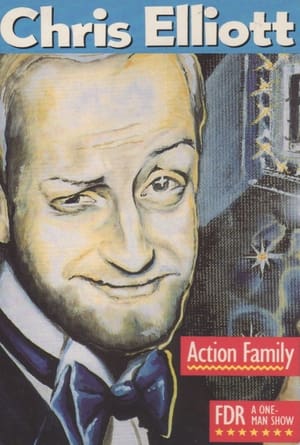
Chris Elliot plays FDR in his live "One Man Show" about the life and times of the president, however, he looks and sounds nothing like the man and he re-enacts events from Roosevelt's life that never happened.
Documentary on a murder associated with members of Savannah, Georgia society. This becomes an occasion to delve into the interaction of Savannah's high life and low life in lurid detail: the mores, the eccentric residents, and the history of this coastal city.
Ten years after the death of iconic French filmmaker, Chris Marker. A filmmaker, hoping to rediscover that unique sensibility against the uncertainty of the new century, returns to the places synonymous with those incomparable and unforgettable films-- From the cat cemetery of Sans Soleil, to the mausoleum of The Last Bolshevik; The caves of Level Five to the rooftops of The Case of the Grinning Cat. A biographical portrait of one of the 20th century's greatest and most misunderstood filmmakers.
The film follows journeys of observational tours solicited by the Palestinian Museum and conducted by two professors from Birzeit University to collect photos of and information on the Palestinian Flora. The title is adapted from a collection of 123 images (circa 1900 to 1920) of wild flowers in Palestine found in the Matson Collection in the Library of Congress. Despite the tendency to trace the wild plants, the text in general aims at questioning the territorial extension of what is meant by the term “Palestinian”, while standing on insignificant topographical features of the (postcolonial) landscape in West Bank. Furthermore, it addresses photography as a practice and a tool of distributing and restricting information at once.
Lies are just another way of telling the truth. The desire to believe is the hand of the man hanging from a cliff and clinging to the only stone that would seem to save him. But he always ends up falling because the stone is a mirage, just as the cliff is. Death is awakening from this dream in which the essential can be said and in which the continuous and infinite has a beginning, an end and a meaning.
Since its release in 1968, Planet of the Apes, the masterful film directed by Franklin J. Schaffner and starring Charlton Heston, and its subsequent sequels have asked its viewers challenging questions about contemporary society under the guise of a bold science fiction saga: a fascinating look at a hugely successful pop culture phenomenon.
A desktop documentary that focuses on the Golden Record that NASA sent into space in the late 1970s. The piece reflects on issues such as the power of scientific discourse to produce revisions of the world, the evolution of the concept of the archive and the resignification of borders in the rhetoric of space colonialism.
Near Munich, in Bavaria, Germany, is the Schleißheim Palace, where French filmmaker Alain Resnais shot his film Last Year at Marienbad in 1960. Nearby is the Dachau concentration camp, where thousands of people were killed between 1933 and 1945. An essay about the present and the past, beauty and horror, life and death.
A tribute to actresses, approaching their presence in and out the screen, humanizing the icons. From the Ukrainian Anna Sten to the French Anna Karina, we can see some close-up faces that marked the history of the cinema, and whose demand is more relevant than ever.
German actor Conrad Veidt is best remembered for playing Nazi Major Strasser in Casablanca. In reality, he was an ardent anti-fascist who left Nazi Germany for Britain, falsely claiming to be Jewish in solidarity with his Jewish wife. Using clips from Veidt’s films, acclaimed director Mark Rappaport imagines the actor narrating his life and career from the silent era—including his leading roles in The Cabinet of Dr. Caligari and The Man Who Laughs through to his Hollywood years where he often played a Nazi.
A fictionalized biography on John Dall who was in two great movies - Alfred Hitchcock’s Rope (1948) and Joseph H. Lewis’ Gun Crazy (1950).
"Fly too high and you will burn, go too low and you won't breathe." A 7 day vlog during the summer of 2023, a story of dreamers and drowners.
What could have happened – what should have happened – if two giants in film history, like Greta Garbo and Sergei Michajlovič Eisenstein, could have declared their love for each other? The world's most famous actress, an honorary Russian citizen of cinema for her many performances; the world's most radical director, who could have immortalized her face in one of his famous close-ups? Sphinx Garbo did not want to be alone: she just wanted to marry the great Sergei. Perhaps she could have played Trotsky or Pancho Villa in one of his films. Perhaps their friends Charlie Chaplin, Walt Disney and Josef von Sternberg would have approved their love. Maybe they could have had a child together. Maybe all this could still have happened, in a Mark Rappaport film.
Le Chevalier de Saint-Georges overcame class and race prejudices in 18th century France to become a musical genius who would inspire Mozart.
HIPERTEXTO
A video essay where the author presumes motivations and insights in a fictionalized biography regarding Debra Paget, a contract player for 20th-Century Fox whom they groomed and coached for stardom.
Joan Crawford's close-up in Humoresque. Michelangelo's David and Boticelli's "Birth of Venus". Stendhal was overwhelmed by the cultural overstimulation in Florence, which Graziella Magherini described scientifically in 1979 as Stendhal syndrome. Mark Rappaport describes his fascination for the Austrian actor Turhan Bey, who made a career in exotic roles in Hollywood in the 1940s. A very personal essay about the effect of close-ups, the canvas idols of the dream factory and the role of their admirers and fans.
Deceased but not forgotten. In 2017, Switzerland's most famous mountaineer, "Swiss Machine" Ueli Steck, fell to his death in the Himalayas when he was just 40 years old. Three close friends travel again to the Everest region where he died. His family in Emmental has to deal with premature death.
What begins as an impassioned defense of empathy in children's programming takes Lindsay Ellis down a rabbit-hole to the likes of Ben Shapiro, Fred Rogers, and King Solomon, while finally leading us to a place of devastation and anger at the state of the world.
In this revisionist documentary, actor Eric Farr re-creates the character of Rock Hudson in order to take a look back at his films. It compares the actor's screen (and public) image with his real life and shows certain scenes, lines and situations in his films to insinuate that Hudson may have been gay.