A game show set in a galaxy far, far away, which tests young contestants’ abilities in the core Jedi principles of strength, knowledge, and bravery as they face thrilling and fun obstacles in an attempt to achieve the rank of Jedi Knight
A game show based on the Carmen Sandiego computer game series created by Brøderbund Software.
Family Feud: La batalla de los famosos
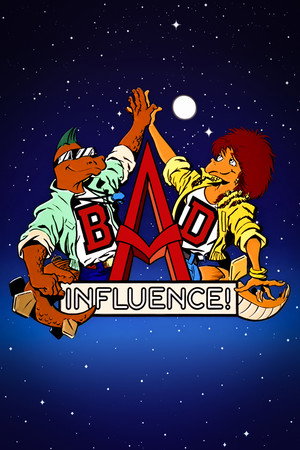
Bad Influence! is an early to mid-1990s British factual television programme broadcast on CITV between 1992 and 1996, and was produced in Leeds by Yorkshire Television. It looked at video games and computer technology, and was described as a "kid’s Tomorrow's World". It was shown on Thursday afternoons and had a run of four series of between 13 and 15 shows, each of 20 minutes duration. For three of the four series, it had the highest ratings of any CITV programme at the time. Its working title was Deep Techies, a colloquial term derived from 'techies' basically meaning technology-obsessed individuals.
Five contestants attempt to answer top 10 list questions for the chance to win a big cash prize.
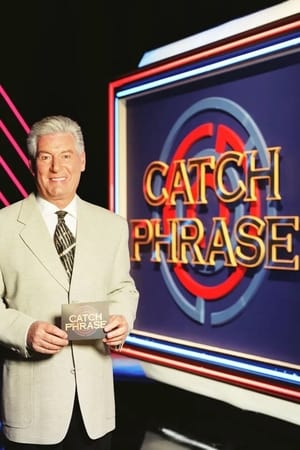
Stephen Mulhern hosts this remake of the 1980's game show where contestants have to guess a catchphrase based on animated picture clues. The puzzle is revealed one square at a time. It could be a book, a movie or a catch phrase. The winner with the most money can go on to win up to £50,000.
Catchphrase is a British game show based on the short-lived U.S. game show of the same name. It originally aired on ITV in the United Kingdom between 12 January 1986 and 19 December 2002. It was presented by Northern Irish comedian Roy Walker from 1986–1999; followed by Nick Weir from 2000–2002, and Mark Curry in 2002. In the original series, two contestants, one male and one female would have to identify the familiar phrase represented by a piece of animation accompanied by background music. The show's mascot, a golden robot called "Mr. Chips", appears in many of the animations. In the revived version of the show, the same format remains, but there are three contestants. In August 2012, it was announced that Stephen Mulhern would host a revived version of the show beginning on 7 April 2013. On 21 August 2013, it was confirmed that Catchphrase has been re-commissioned for a second series, following the success of the first.
Hollywood Squares is an American panel game show, in which two contestants play tic-tac-toe to win cash and prizes. The "board" for the game is a 3 × 3 vertical stack of open-faced cubes, each occupied by a celebrity seated at a desk and facing the contestants. The stars are asked questions by the host, or "Square-Master", and the contestants judge the veracity of their answers in order to win the game. Although Hollywood Squares was a legitimate game show, the game largely acted as the background for the show's comedy in the form of joke answers, often given by the stars prior to their "real" answer. The show's writers usually supplied the jokes. In addition, the stars were given question subjects and plausible incorrect answers prior to the show. The show was scripted in this sense, but the gameplay was not. In any case, as host Peter Marshall, the best-known "Square-Master" and the man in whose honor the show's first announcer, Kenny Williams, actually "coined" the term, would explain at the beginning of the Secret Square game, the celebrities were briefed prior to show to help them with bluff answers, but they otherwise heard the actual questions for the first time as they were asked on air.
Le Juste Prix is a French adaptation of the American game show The Price Is Right that airs on TF1. It first premiered in 1988 and ran until the original version was canceled in 2001. In 2002 a brief sequel, Le Juste Euro, ran on France 2 and was hosted by Patrice Laffont, it only ran for two episodes. On July 27, 2009 a new version of Le Juste Prix premiered on TF1. The current version is hosted by Vincent Lagaf with Gerard Vivès as announcer.
In a race with time, celebrity contestants desperately try to outmaneuver black-clad Hunters in pursuit, for a chance to win a growing cash prize.
In a Temple filled with lost treasures and protected by mysterious Mayan temple guards, six teams of two children compete to retrieve one of the historical artifacts in the Temple by performing physical stunts and answering questions based on history, mythology, and geography. After three elimination rounds, only one team remains, who then earns the right to go through the Temple to retrieve the artifact within three minutes and win a grand prize.
80 treasure hunters will compete for 10 million rubles on a desert island.
The second version of the American television game show.
Storybook Squares is a short-lived Saturday morning version of Hollywood Squares for children. The primary difference, apart from having children as contestants, was that it featured celebrities in costume as well-known fictional characters and some as historical figures. As with the adult version, Peter Marshall was host and Kenny Williams was announcer; Williams read the characters' names off a scroll as "The Guardian of the Gate", a role similar to his "Town Crier" on Video Village. The series originally ran on NBC from January 4 to April 19, 1969, with repeats airing until August 30.
Get Your Own Back was a British children's game show, which ran from 26 September 1991 to 31 March 2003. It has been presented throughout by Dave Benson Phillips with the addition of Lisa Brockwell as a co-host from 2001 to the programme's end in 2003.
A game show set and filmed on the real Fort Boyard in France. The contestants have to complete in physical and endurance challenges to win prize money.
Four participants, two teams and one premise: don't drop the ball. English actor and comedian Paddy McGuinness presents this new game show, that combines brains with physical abilities. A new twist to the classic question-answer game show. If the participants answer correctly, then the ball will fall directly on them. However, if they provide the wrong answer, they will have to run so they can catch the ball before it touches the ground, and stay in the competition to win the grand prize of 10,000 pounds.
Strike it Lucky was a popular British television game show from 29 October 1986 to 23 August 1999, originally produced by Thames Television for ITV, and presented by the British comedian Michael Barrymore. It was based on the American show of the same name that aired in 1986. In its formative years, it became well known for the outlandish and often highly eccentric contestants it featured - Barrymore would often spend over 5 minutes talking to them. The introductory footage of the prizes on offer were also noteworthy, often filmed in black-and-white with a slapstick style. In 1987, it was the fifth most watched programme on UK television. The Thames Television version of the show was recorded at Teddington Studios, and later Pinewood Studios. From 1996, the new version aired under the title Strike it Rich!; this being the title of the short-lived American game show Strike it Rich! on which it was based, and it moved to The London Studios. The reason for the name change was that the show was now being co-produced by LWT with Fremantle, so despite now being owned by the same company as Fremantle, Thames were unwilling to allow LWT use of the original title. There is also the factor that when the show was first exported to the UK, the Independent Broadcasting Authority's prize limits were still in place, and "Rich" was probably dropped from the title because of the relatively low value of prizes on offer; by the time it returned as Strike it Rich! the limits had been lifted and it was giving away a substantially higher value of prizes.
You Should Be So Lucky! was a BBC children's television programme hosted by Colin Bennett in the character of Vince Purity. It was a game show, during which contestants played on a giant snakes and ladders board. Points were earned by their team partners through talent tasks.
A gameshow hosted by Ant and Dec filled with stunts, sketches, and special guest appearances.