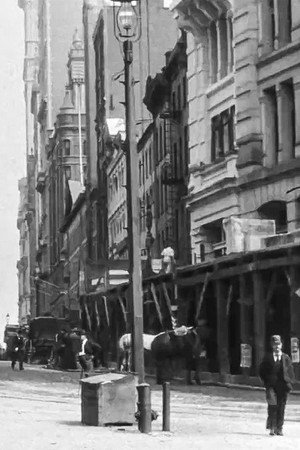
Taken in 1896 on the Boulevard (upper Broadway) on the occasion of a bicycle parade in the heyday of the wheeling craze. Old-fashioned horse cars lend interest to the scene.
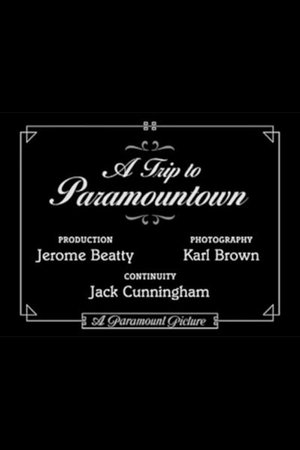
Documentary short film depicting the filmmaking activity at the Paramount Studios in Hollywood, featuring dozens of stars captured candidly and at work.
This silent film from 1948 "The Creation of Life" briefly demonstrates how a fetus forms and graphically shows different types of births. It was made by Sherwood Picture Corp., and may have been sold both to schools and professional organizations for medical education, and to the public for shock value. (Several similar birth films were sold in this era through home catalogs and photography shops.) Summary: By means of diagrams, conceptions and pregnancy are explained. Views of various methods of delivery are shown. Created by: T. Marc Sherwood
a cycle of silent color 8mm films by the American experimental filmmaker Stan Brakhage
Shows masked mental patients enacting various schizophrenic symptoms as they were understood at the time. A disturbing film that raises questions about the condition and treatment of its subjects. (archive.org) “Abstract: This film describes and demonstrates four types of schizophrenia. Filmed at various New York institutions, it shows patients singly and grouped in large, outside recreational areas. Some patients are blindfolded. Symptoms shown include: social apathy, delusions, hallucinations, hebephrenic reactions, cerea flexibilitas, rigidity, motor stereotypes, posturing, and echopraxia.” (Guide to Mental Health Motion Pictures)
Mudos testigos is a cinematographic collage made from all the surviving material of Colombian silent films, re-editing the images in such a way as to create a single imaginary film: the impossible love story of Efraín and Alicia that traces the convulsive first half of the twentieth century in Colombia. Compiled by the late Luis Ospina and finished posthumously by Jeronimo Atehortúa.
Elam turns in place while filming nature.
Contrasting environments, in and outside.
Andy Warhol directs The Factory regular Louisa "Jackie" Foster for a screen test.
This footage is almost entirely black, save for a few shots possibly showing electric poles outside.
A covered bridge and the nature surrounding it.
Elam records several men moving boxes and furniture as they track across her backyard.
An outdoor gathering.
Peter Hutton's New York trilogy. An act of urban archaeology, a chronicle of indelible impressions of the city.
Farm work and nature.
Chicago streets.
A contemplative, seemingly timeless record of the years Hutton spent in Southeast Asia while working as a merchant seaman. Jon Jost writes, "The film is rich with truly wonderful visions: a thick, white porcelain cup perched on a ship's rail, the tea within swaying gently in sync with the ship while the sea rushes by beyond the faces of crewmen posing awkwardly but also movingly for the camera; a cockfight on ship; scenes from a bucolic pre–Pol Pot Phnom Penh. Images has the haunting elegiac resonance of Eugène Atget's Paris, the echo of a time and place that was." - MoMA
Elam's husband prepares vegetables at the sink.
“Tai Chi II,” similarly to Elam’s “Tai Chi Bowling” and “Tai Chi,” focuses on movement. Through a sequence of close-ups, Elam coyly records portions of several individuals practicing tai chi, primarily focusing on the practitioners’ extremities as they float about. Distinct from its affiliates, “Tai Chi II” finds the action taking place outside.
24