From the Teatro dell'Opera di Roma Terme di Caracalla "Carmen" by Georges Bizet. Director Jesus Lopez-Cobos. Orchestra, Chorus and Corps de Ballet of the Teatro dell'Opera di Roma.
Bohuslav Martinů's Greek Passion, which outlines a serious, very topical problem today, which is the position of refugees in a foreign, often hostile environment, is among the composer's most important works in terms of both ideology and art. The English libretto was based on the novel "Christ Recrucified" (1951) by the Greek writer Nikos Kazantzakis, which takes place in the first decades of the 20th century in the harsh Greek countryside.
Known as a creator of astonishing images, stage director and visual artist Robert Wilson delivers a magnificent production of Mozart’s adaption of Handel’s Messias. Mozart was commissioned by Gottfried van Swieten to modernise the score fifty years after Handel’s popular composition (1742), mainly by arranging the wind parts and partially re-composing them. With Marc Minkowski a conductor has been engaged who understands perfectly how to combine baroque style with the tonal possibilities of an orchestra of the classical period like the Musiciens du Louvre. The excellent soloist quartet with Elena Tsallagova, Wiebke Lehmkuhl, Richard Croft and José Coca Loza merges perfectly into Wilson’s enormous flood of images.
A short experimental film shot on Super 8, inspired by the music of Richard Wagner.
“Foolish indeed is he who marries in old age.” Thus ends Don Pasquale: with a wise dictum not lacking in irony that sums up the disappointments of its hero, a rich bachelor keen to marry who is deceived by his nephew Ernesto and his young bride-to-be Norina. First performed in Paris in 1843, at the turning point of several eras, Don Pasquale, a composite and varied work, is the apotheosis of opera buffa. Performed for the first time at the Paris Opera, the production has been entrusted to the Italian director, Damiano Michieletto, who transports us directly to the sincerity and dramatic splendour at the heart of an apparently light‑hearted work.
Miller’s daughter Zuzanka Vojířová, betrothed to Ondřej Zachar, hesitates before marriage when Lord Peter Vok of Rožmberk invites her to his castle. There she bears his son Petříček, but his wife hides the child. After Vok’s death in battle, Zuzanka is expelled and lives as a beggar, reunited with her son and former fiancé, finding solace in the continuation of the Rožmberk lineage.
Carmen is a French-Italian musical drama film directed by Christian-Jaque and starring Viviane Romance, Jean Marais, and Lucien Coëdel. It is a version of the famous opera. It was filmed in two versions, French and Italian, with the same screen cast but some different crew, and with Italian voices dubbed in on the Italian version, which have been munged together at IMDb. A third version, with English dubbed under the direction of British actor Noel Howlett, was made subsequently using one of the two (French or Italian) originals for the visual source.
Two men meet and confront each other over a woman. Visibly different in appearance, the two men engage in a continuous battle of nerves. While the woman steps out to use the restroom, the men go up to the rooftop and start arm wrestling.
PRELIMINARY EVENINING OF THE RING CYCLE. Upon the banks of the ageless river Rhine, the Rhinemaidens play. Alberich, a Nibelung dwarf, tries vainly to seduce one of them. To taunt him, they reveal their secret: out of the gold they guard one can forge a Ring to rule the world, but at the cost of giving up Love forever. Alberich steals the gold, makes the ring and plans his world take-over. Meanwhile, Wotan, King of the Gods, must figure out how to finance the construction of Valhalla. He has promised his sister-in-law as payment to the giant construction workers led by Fafner, but his wife Fricka disapproves. Loge (God of Fire) tricks Alberich and brings him to Wotan, who takes the Ring. In revenge Alberich curses it: lack of the Ring will fuel desire for it and possession will only lead to misery. Wotan gives the Ring to Fafner as ransom for Fricka's sister. Filmed at the Bayreuth Festspielhaus in June & July 1991.
SECOND DAY OF THE RING CYCLE. Alberich's brother Mime raises the orphan Siegfried, hoping that Siegfried will kill Fafner and enable Mime to gain the ring. Mime attempts unsuccessfully to reforge the Nothung. Fulfilling prophecy, Siegfried reforges the sword himself and kills Fafner, who has the form of a dragon. When he accidentally tastes the dragon's blood spilt on his hands, Siegfried understands the song of a woodbird, who instructs him to take the Ring from Fafner. Reading Mime's thoughts of betrayal, Siegfried kills the dwarf as well. The woodbird also informs Siegfried of a mysterious woman asleep in the midst of fire, and Siegfried sets off to find her. After defeating a disguised Wotan and breaking his spear, Siegfried successfully awakes Brünnhilde, and the two fall in love. Filmed at the Bayreuth Festspielhaus in June & July 1992.
THIRD DAY OF THE RING CYCLE. Günter, the lord of the Rhine people, gives Siegfried a love potion that causes Siegfried to forget Brünnhilde and fall in love with Günter's sister Gutrane. Siegfried has given Brünnhilde the Ring as a token of their love, but her Valkyrie sister urges her to destroy it, because their father Wotan has lost his spear and power and is hiding out in Valhalla. Instead, Brünnhilde keeps it, and under the influence of the potion, Siegfried steals it from her. Enraged, Brünnhilde helps Alberich's son murder Siegfried, but Siegfried's memory returns, and he dies thinking of Brünnhilde. Brünnhilde repents and orders a funeral pyre to be built. She rides into the fire herself, and the Rhinemaidens get the ring back. The story closes with flames flickering about Valhalla in the background. Filmed at the Bayreuth Festspielhaus in June & July 1991.
This is a beautifully conducted and thoughtfully staged performance of the first opera (the prologue) in Wagner's Ring Cycle. As soon as the clouds of mist have dissipated, while the daring, long-held opening chord is still reverberating, the screen clears to show not only the River Rhine and the three maidens (dressed like prostitutes in this production) assigned to guard the gold hidden there. It also shows an enormous dam (not mentioned in Wagner's text). This is the underwater base of a hydroelectric plant, and its presence tells us two things immediately: that this production takes the story out of the vaguely medieval fantasy world in which Wagner had placed it, and that a basic theme of the four-opera cycle would be power. Alberich, the Nibelung, is willing to renounce the love of women, after stealing the gold from the Rhine, to become the ruler of the world. Another basic theme is greed.
Birgit Nilsson and Jon Vickers star in this filmed record of the Theatre Antique d'Orange's acclaimed 1973 production of Wagner's epic tale of doomed love in the Middle Ages. Tristan und Isolde also features the Orchestre National de R.T.F., under the direction of Karl Bohm.
In its most ambitious effort yet to bring the joy and artistry of opera to audiences everywhere during the Met’s closure, the company presented an unprecedented virtual At-Home Gala, featuring more than 40 leading artists performing in a live stream from their homes all around the world.
Benjamin Britten’s opera Gloriana was written in 1953 for celebrations around the Coronation of Her Majesty Queen Elizabeth II, to whom the opera is dedicated. It had its first performance at the Royal Opera House on 8 June 1953, in the presence of The Queen then just 6 days into her reign. The centenary in 2013 of Britten’s birth prompted this new Royal Opera production, in which director Richard Jones uses the setting of a celebratory pageant in 1953 to explore the work’s alternating splendour and intimacy. This theatrical, inventive and colourful staging has at its core the symbolic reflections between the Tudor Elizabethan and the New Elizabethan ages that characterize the opera. The juxtaposition of the modern and the archaic in William Plomer’s libretto is wonderfully amplified in music that artfully fuses the sounds and manners of Tudor England – from lute songs to courtly dances – with Britten’s own distinctive style.
Giacomo Meyerbeer's pastoral opera,based on a Breton tale, is the tale of DINORAH who has gone mad because her bridegroom Hoël has disappeared during their wedding. This production, performed as part of Théâtre Impérial de Compiegne's purpose of reviving obscure French opera, is the only version of 'Dinorah' available on DVD, but it is a great production! The painterly pastoral settings and décor and rustic costumes are very easy on the eye. Opera traditionalists who dislike modern stagings will be delighted to know that this is a traditional production. Pierre Jourdan's stage direction is charming and always involving, never once falling into static movements or gestures, gratuitous distaste and irrelevance. With Isabelle Philippe, Armand Arapian and Frédéric Mazzotta. Conducted by Olivier Opebeek.
This is the story about Setyo, Siti and Ludiro, who were the performer of Javanese Ramayana's Wayang Wong. Setyo and Siti are spouse who live in a village by selling earthenware products. In the village, live as well Ludiro, the head of the stockyard, who is very wealthy and secretly in love with Siti. Conflicts arrived as Setyo's earthenware company is going bankrupt and Siti started to took notice in Ludiro's desire to win her love. These triangle love transform into a civil war in the village that brings not only extremity and injustice, but also the death of the loved ones.
Isabella is a strong, independent woman who has no intention of giving in to the clumsy advances of the powerful Mustafà. In the production by BAFTA winners Mosh Leiser and Patrice Caurier, which plays with prejudices about clashing cultures, Mustafà is no longer an Ottoman bey, but a shady gangster who traffics electronic goods in the port of Algiers.
Les contes d'Hoffmann - Opéra Bastille novembre 2016
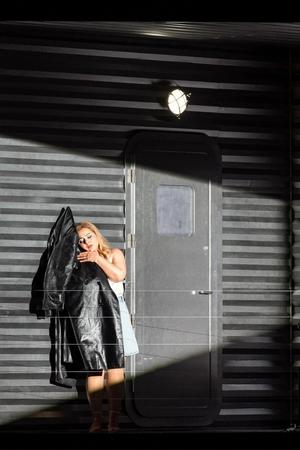
Two-time Tony Award–winning composer Jeanine Tesori’s powerful new opera Grounded, commissioned by the Met and based on librettist George Brant’s acclaimed play, wrestles with the ethical quandaries and psychological toll of 21st-century warfare.