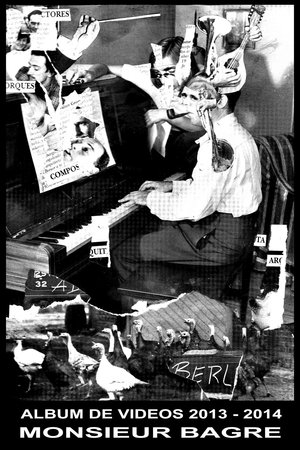
An unnamed passer-by is forced to trace a circular route inside an abandoned tram station, facing loss and time. The broken walls act as a channel, transmitting fragmentary, blurred and analogical memories.
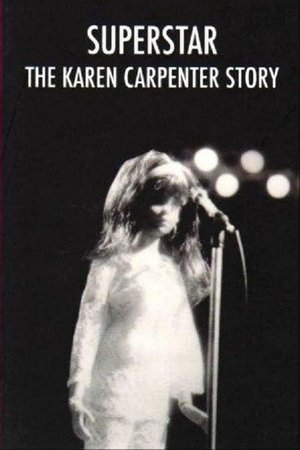
The final 17 years of American singer and musician Karen Carpenter, performed almost entirely by modified Barbie dolls.
Global Groove was a collaborative piece by Nam June Paik and John Godfrey. Paik, amongst other artists who shared the same vision in the 1960s, saw the potential in the television beyond it being a one-sided medium to present programs and commercials. Instead, he saw it more as a place to facilitate a free flow of information exchange. He wanted to strip away the limitations from copyright system and network restrictions and bring in a new TV culture where information could be accessed inexpensively and conveniently. The full length of the piece ran 28 minutes and was first broadcasted in January 30, 1974 on WNET.
Strings together what's strung together (please use yr tether).
A short film recounting the travels of a lonely astronaut confronted by the unknown. Unfolding as a mystery, it becomes a carefully subtle, autobiographical examination of the feeling of loneliness and the existential issue of not understanding life on earth and ones place among it.
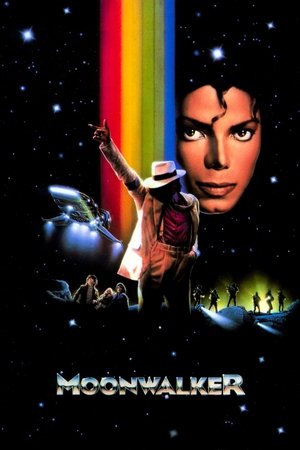
This fantastical movie inspired by the music of Michael Jackson features imaginative interpretations of hit tracks from the iconic 1987 album “Bad”.
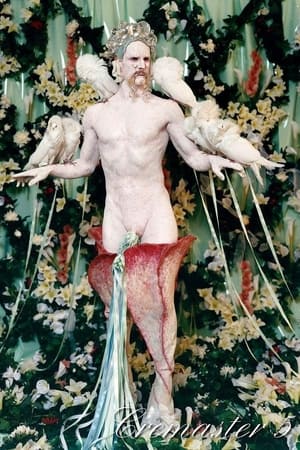
Cremaster 5 is a five-act opera (sung in Hungarian) set in late-ninteenth century Budapest. The last film in the series, Cremaster 5 represents the moment when the testicles are finally released and sexual differentiation is fully attained. The lamenting tone of the opera suggests that Barney invisions this as a moment of tragedy and loss. The primary character is the Queen of Chain (played by Ursula Andress). Barney, himself, plays three characters who appear in the mind of the Queen: her Diva, Magician, and Giant. The Magician is a stand-in for Harry Houdini, who was born in Budapest in 1874 and appears as a recurring character in the Cremaster cycle.
A visual interpretation of the poem by E.E. Cummings about the life cycle of a townspeople and of one ignored couple.
A huge, run-down apartment in Berlin Mitte. Two women and a man, rehearsals for a movie about love and sex, that will never be shot. Acting and reality mingle into a dangerous mélange.
A live performance film capturing an intimate concert by composer, pianist and music producer Ryuichi Sakamoto in New York City. The performance marked the first public unveiling of Sakamoto’s new opus, async, hailed as one of the best albums of 2017 by Rolling Stone and Pitchfork.
An experimental music ensemble is recording an album. They want a very specific sound: the sound of thick air. The sound engineer struggles to understand and to find that sound. A tale of sleepless nights and loud music, a noise-injected collage composed of diaristic footage, a found narrative (memories of a popular 60s band), original music and field recordings.
Four types of visual interpretation of four songs by Karol Szymanowski. Polish words by Julian Tuwin, English translation by Jan Sliwinski.
Dislocation in time, time signatures, time as a philosophical concept, and slavery to time are some of the themes touched upon in this 9-minute experimental film, which was written, directed, and produced by Jim Henson. Screened for the first time at the Museum of Modern Art in May of 1965, "Time Piece" enjoyed an eighteen-month run at one Manhattan movie theater and was nominated for an Academy Award for Outstanding Short Subject.
Hand painted directly onto film stock by Margaret Tait, this film features animated dancing figures, accompanied by authentic calypso music.
As a child, the brutal murder of her family made Alexis regain her hearing along with synesthetic abilities. Now as an adult, she finds solace in the sounds of bodily harm. But when she’s told she might lose her hearing again, she escalates her gruesome sound experiments in a quest to compose her masterpiece.
A young man and his dog encounter a sinister force while on a walk through the woods.
Maya Deren’s shortest, two-minute A Study in Choreography for Camera seems like an exercise piece to capture a dancer’s movement on celluloid, which later on developed into her masterpieces such as Ritual in Transfigured Time and Meditation on Violence.
Dancers, shown in photographic negative, perform a series of ballet moves, solos, pas de deux, larger groupings. The dancers glide and rotate untroubled by gravity against a slowly changing starfield background. Their movements are accompanied by music scored for a small ensemble of woodwind and percussion.
Cinematic magician, legendary provocateur, and author of Hollywood Babylon, Kenneth Anger was a unique figure in post-war American culture. His iconic short films are characterised by a mystical-symbolic visual language and phantasmagorical-sensual opulence that underscores the medium’s transgressive potential. Anger’s work fundamentally shaped the aesthetics of 1960s and 1970s subcultures, the visual lexicon of pop and music videos and queer iconography. These nine films form the basis of Anger’s reputation as one of the most influential pioneers of avant-garde film and video art. Fireworks, 1947, 14 min Puce Moment, 1949, 6 min Rabbit's Moon, 1950/1971, 16 min Eaux d'Artifice, 1953, 13 min Inauguration of the Pleasure Dome, 1954, 37 min Scorpio Rising, 1964, 28 min Kustom Kar Kommandos, 1965, 3 min Invocation of My Demon Brother, 1969, 11 min Lucifer Rising, 1981, 27 min
A person desperately searches for their lost little brother during a Memorial Day festival in this one take POV thriller