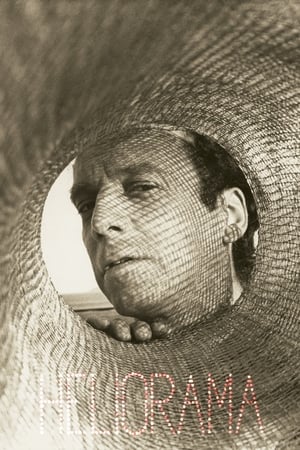
A collage of newsreels, trailers, clips and other visionary and unseen fragments of sight and sound regarding the late plastic artist Helio Oititica.
For us, a thought always presupposes a society, a culture and above all the consciousness of time. We are haunted by immortality, human notion par excellence. As if the world was here to fascinate us. And to disappoint us. The film travels around the bulb like the Earth around the Sun. Light makes the film visible. A fragile film, like our existence. In the orbit of the film tragedy and our reality, the image resists the cruelty of the experiment.
'The angle of the world allows us to see the real as an outer and inner presence at the same time, an opaque otherness, yet capable of becoming an intimate space. These incommensurable lengths and distances of an interior that opens up: The mysterious movement of the clouds, the cadence of the waves against the light, or the silent slippage of a barely identifiable human silhouette, everything seems transfigured, derealized and reinvented by light in a poetic world that evokes the paintings of Turner or Friedrich, the writings of Poe or Baudelaire.’ — Violeta Salvatierra
The term "The Weir-Falcon Saga" appeared to me, night after night, at the end of a series of dreams: I was "true" to the feeling, tho not the images, of those dreams in the editing of this and the following two films. The three films "go" very directly together, in the order of their making (as listed); yet each seems to be a clear film in itself. At this time, I tend to think they constitute a "Chapter No. 2" of The Book of Film I've had in mind these last five years (considering SCENES FROM UNDER CHILDHOOD as Chapter No. 1); and yet these "Weir-Falcon" films occur to me as distinct from any filmmaking I have done before. (Stan Brakhage)
Mid-period Brakahge short. "Haiku cartoons."
"...Series of narrative events, stories if you like, but so clustered visually as to have a center so to speak, slightly off center."
The following films were all made in 1976. I do not wish to describe them. —SB "Two portrait sketches and two nondescript."
A faceless protagonist witnesses the alienation of gentrification as his home is overtaken by development. the forces behind it are demanding him to leave, but also consequently push him further and further into his not-home.
What minimalistic techno looked like in 1910?
Creeping from the halls of the maze brain, corruption and terror is woven by devils born from the denied errors of mankind.
A concert at the Golden Circle with Don Cherry and his quintet was filmed and then processed to an art movie using various optical effects.
Based on D.H. Lawrence's "Lady Chatterley's Lover" and one of the pioneering films of the Iranian New Wave
A thrillingly lo-fi salute to the old-school, hand-crafted special effects that were once a mainstay of pre-CGI science-fiction films.
Each day after work, Carlos, a language school teacher, frequents the heady surroundings of his local cruising ground. One evening he encounters a teenage boy from his class named Toni, and the two engage in a brief sexual tryst. As the relationship between teacher and student begins to develop, some dark truths emerge about the young man and his mysterious group of friends.
A production company begins casting for its next feature, and an up-and-coming actress named Rose tries to manipulate her filmmaker boyfriend, Alex, into giving her a screen test. Alex's wife, Emma, knows about the affair and is considering divorce, while Rose's girlfriend secretly spies on her and attempts to sabotage the relationship. The four storylines in the film were each shot in one take and are shown simultaneously, each taking up a quarter of the screen.
The film includes sections which explore the illusion of movement within the frame, the movement created by the filming and projection equipment, of movement suggested by camera manipulation (e.g. zoom, re-focus, etc.). Structural Studies exemplified the Hein’s central project of elaborating the central process of the cinema, situating those processes equally in terms of artistic production and mechanical reproduction.
A short Japanese experimental film
Pyramid is a single screen work on Abraham Maslow's theory on the hierarchy of human needs filmed through the rhythms and choreography of middle class South England. Filmed in color and b&w on 16mm film, it continues Salmon's interest in the performance of the artist/cinematographer within both spontaneous and constructed situations and incorporates methods developed by various movements within documentary and avant-garde history. Using an array of sounds, music and conversation as well as silence, Salmon constructs an abstract documentary which both develops and challenges the themes presented in Maslow's theory as well as her own interest in human iconography, stereotype and domestic rhythm. The image of Maslow's pyramid and his pragmatic dissection of human needs and possible motivations provide a system of organization for the family and a philosophical framework for the video.
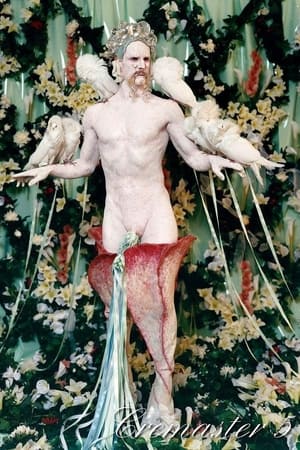
CREMASTER 5 is a five-act opera (sung in Hungarian) set in late-ninteenth century Budapest. The last film in the series, it represents the moment when the testicles are finally released and sexual differentiation is fully attained. The lamenting tone of the opera suggests that Barney invisions this as a moment of tragedy and loss. The primary character is the Queen of Chain (played by Ursula Andress). Barney, himself, plays three characters who appear in the mind of the Queen: her Diva, Magician, and Giant. The Magician is a stand-in for Harry Houdini, who was born in Budapest in 1874 and appears as a recurring character in the Cremaster cycle.
Vi.sion is the product of an encounter between an expanding ballet troupe and an abandoned school with a marvelous theater, which was to be demolished to make way for a parking lot. It is the home of a place, imbued with memories of a rich and proud past, by the footsteps of a young troop. The time is getting confused. The present and the past blend together and it is the old school that dances with the passion and passion of young dancers. Ghosts, shadows, specters ... They bewitch.