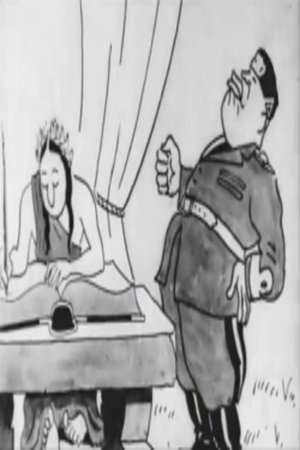
Adapting Jaroslav Hasek's raucous satirical novel, and also bringing Josef Lada's equally famous illustrations to garrulous puppet life, posed Trnka one of his biggest creative challenges. Trnka himself felt that the final episode was the most artistically successful, but there's much to enjoy in all three, not least the way that the lackadaisical layabout Svejk's own self-serving anecdotes are realized through cut-out animation.
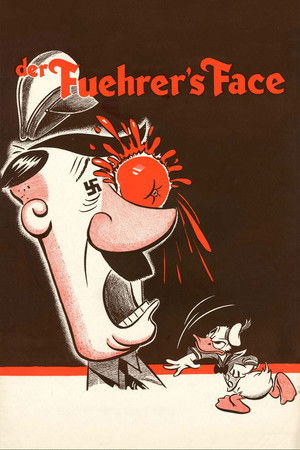
A marching band of Germans, Italians, and Japanese march through the streets of swastika-motif Nutziland, serenading "Der Fuehrer's Face." Donald Duck, not living in the region by choice, struggles to make do with disgusting Nazi food rations and then with his day of toil at a Nazi artillery factory. After a nervous breakdown, Donald awakens to find that his experience was in fact a nightmare.
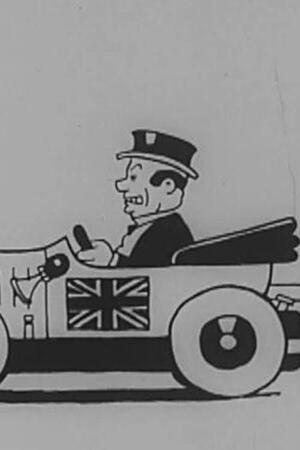
First World War animated propaganda short, extolling Britain's naval history and mocking the German navy.
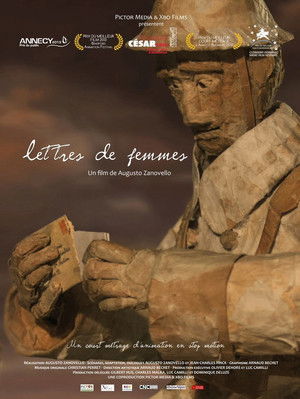
On the front lines of the Great War, nurse Simon repairs the broken faces of the soldiers every day with love letters, words from women that have the power to heal the wounds of these paper soldiers. Simon himself seems impervious to holes, uncreasable, untearable in his white coat. His secret is his war godmother, who occupies all his thoughts whenever he has a moment to breathe. But when death strikes where it is least expected, can words written on paper still erase the pain?
Valentine and Jean-Claude start a new life in Kigali with their newborn baby, Justice. Their country, already battered by racial propaganda and brutality, finally seems ready for peace and justice.
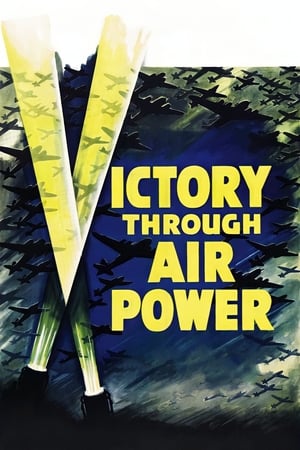
Based on the book by Major Alexander de Seversky's about his theories of the practical uses of long range strategic bombing. Using a combination of animation humorously telling about the development of air warfare, the film shows de Seversky illustrating his ideas of how air power could win World War II for the Allies.
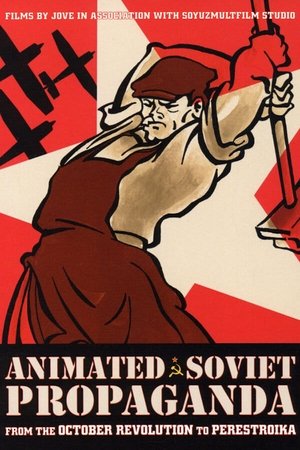
A landmark four disc Box Set - Unearthed from Moscow's legendary Soyuzmultfilm Studios, the 41 films in ANIMATED SOVIET PROPAGANDA span sixty years of Soviet history (1924 - 1984), and have never been available before in the U.S.
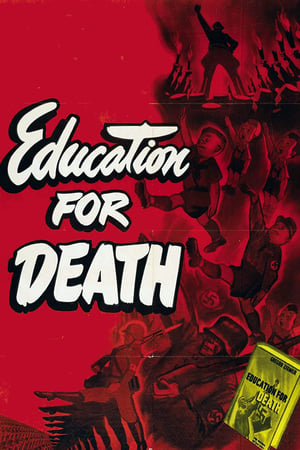
A propaganda film during World War II about a boy who grows up to become a Nazi soldier.
The first Japanese feature-length animated film. It was directed by Mitsuyo Seo, who was ordered to make a propaganda film for the war by the Japanese Naval Ministry. Shochiku Moving Picture Laboratory shot the 74-minute film in 1944 and screened it on April 12, 1945. It is a sequel to Momotarō no Umiwashi, a 37-minute film released in 1943 by the same director. It is black and white. The whole movie also depicts the Japanese "liberation of Asia", as proclaimed by the Government at the time. Seo tried to give dreams to children, as well as to instill the hope for peace, with hidden movie's hints of dreams and hopes, under the appearance of war propaganda.
The Jockstrap Raiders takes place during World War I in Leeds, England. A group of underdog misfits are excluded from the war due to various abnormalities. Threatened by the invading German Kaiser and his army, they must learn to become a team and overcome their deficiencies in order to save Britain and the world.
Lu Dahai and his shipbuilding team want the 10,000-ton ocean freighter "The East" to be given a sea trial. But the ship is made with domestic parts, and Chen Zongjie, a leader of the Party Committee of the Bureau of Foreign Transport, believes that the quality is not sufficient, and orders that the parts be replaced with imported ones before the sea trial takes place. In the end, the sea trial not only sets a successful new record, but also rescues a Taiwanese fishing boat in distress.
A psychedelic animated short celebrating America's bicentennial. The film " provides a short, impressionistic history of the U.S. through famous American symbols, including the Statue of Liberty; the Woodstock logo; the Liberty Bell; and Mt. Rushmore. The symbols are layered on top of each other, as can be seen from a bald eagle hatching from a red, white, and blue egg and flying past the American Gothic farmers, the U.S. Capitol building, the Golden Gate Bridge, Abraham Lincoln’s cabin, and an American bison. The film was directed by Vince Collins" (US National Archives).
Short cartoon made for US military soldiers during World War Two.
The Sailor and the Seagull was released by the U.S. Navy in 1949 with a simple goal: encouraging servicemen to re-enlist. In the film, a disgruntled sailor named McGinty complains about the raw deal he believes he is receiving by serving in the Navy. As luck would have it, a seagull comes to release him from service so that he can experience the freedom of civilian life. McGinty soon learns, however, that civilian life means less freedom and less money than he had imagined and quickly jumps at the chance to re-enlist. (cont. http://blogs.archives.gov/unwritten-record/2013/09/26/sailor-and-the-seagull/)
Peaceful citizens (one of whom resembles Felix the Cat) are dancing to music before their island is being invaded by a gigantic rodent that resembles Mickey Mouse. The islanders contact legendary folk-hero Momotaro from a giant book to battle Mickey.
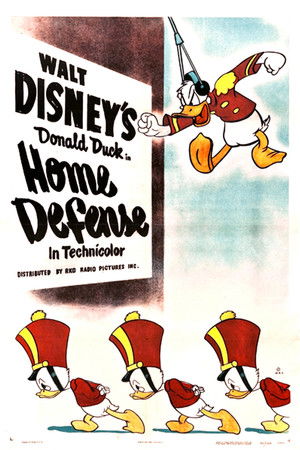
Donald is manning a listening post and falls asleep; he blows trumpet calls in his sleep and wakes his nephews. For their revenge, they send up a model airplane filled with gingerbread men with parachutes; Donald shoots it down, and cowers in fear when he sees the parachutes (and hears a simulated battle), until one lands on his beak. Donald kicks his nephews out until he mistakes a bee for an airplane, and calls them back to fight this menace.
Osudy dobrého vojáka Švejka – Švejkova budějovická anabase
7 Wise Dwarfs is an educational short animated film commissioned by the National Film Board of Canada as a short film for educating the Canadian public about war bonds during World War II. The short features the seven dwarfs from Disney's Snow White and the Seven Dwarfs, four years after the characters made their screen debut.
The entire Disney menagerie appears in a parade urging the purchase of war bonds.
A doctor persuades a group of boys to be vaccinated by explaining how it will protect them against disease. Animated sequences depict the body metaphorically as a city, defended by the blood cells, which are stimulated by vaccination to amass arms and ammunition, in order to defend the city when it is invaded by germs.