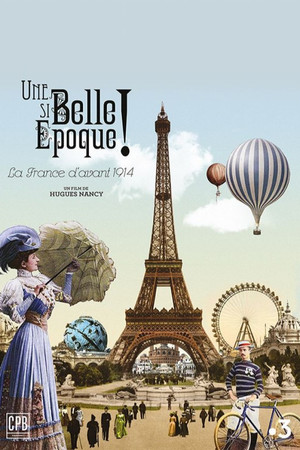
In 1900, the eyes of the whole world are on Paris. The World's Fair welcomed 50 million amazed visitors, and the city celebrated itself in a glamorous era. This period went down in history as the "Belle Époque." Elaborately restored and colorized historical photographs bring to life the exciting life in Paris between the end of the 19th century and the beginning of World War I in 1914. Bicycles, cars, airplanes, moving pictures, newly founded film studios, revolutionary composers and painters, avant-garde ballet performances, fashion houses, summer resorts on the Atlantic coast – life was intoxicating. People celebrate in the variety shows, cabarets, and revue theaters of Paris. Moulin Rouge, Folies Bergères, Bal Tabarin—in Paris, the nights are long and life is too short to sleep through. It is a dance on the volcano, given the political developments in the world.
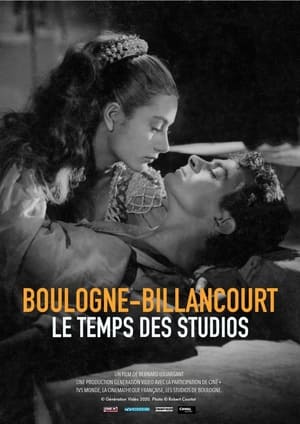
Since 1922, Boulogne-Billancourt cinema studios have welcomed the greatest actors, directors and technicians of French cinema and have given birth to many masterpieces.
In the heart of central Europe are some of the world’s most impenetrable military strongholds. In France, 160 megastructure fortresses still line the country’s borders 3 centuries after they were constructed. As solid as ever, how did they withstand attack after attack? Was the secret in their materials? Their shape? In fact, the strength and resilience of these megastructures is due to the genius of one man: Sébastien le Prestre de Vauban.
Le dernier guillotiné
On a volé le Maréchal !
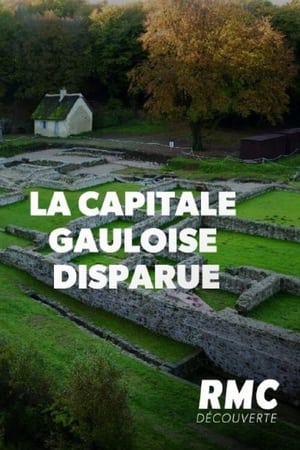
La capitale gauloise disparue
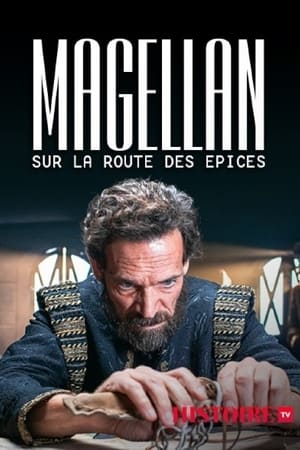
In 1519, Portuguese explorer Fernand de Magellan and his men embarked on an expedition that would forever change the way we see the world. Like Christopher Columbus before him, he set out in search of a western sea route to Asia's legendary Moluccan archipelago.
Moka Malo, des corsaires à la conquête du café
On October 14, 1947, Captain Chuck Yeager accomplished what many thought was impossible: he broke the sound barrier and in doing so, changed aviation history forever. Behind this remarkable achievement was a dedicated team of rocket scientists and engineers, and one incredible plane, a Bell X-1 named "Glamorous Glennis." This is the story of the plane and the people who dared to travel faster than the speed of sound, pushing flight science forward and proving that no matter the barrier, humanity can find a way to break through.
After coming up against homophobia from straight service providers, Queer Gimp Girl (Marg Scott) seeks out other disabled queers and asks about their experiences of disabled awareness and access in the queer communities.
Is art useful to man? The actors are suited to society. Passers-by are people who want to dream but have now lost confidence, laziness on the one hand, conditioning and deschooling on the other, require you to lower your sights and everyone is content to pursue modest cheap expectations. Reality and art are not in communication, impoverished by individualism, the actors and artists dance to the rhythm imposed by power, they slaughter each other, they abuse each other without realizing the possibilities of communication that open up by moving outside the choir. Rome is occupied by every step, the foot walking lightly occupies the public land. But this occupation is not news because it is lightning fast. The criteria of employment mark the time.
A small boy dresses up as a beggar for a fancy dress contest. In the meanwhile, there is a man who joins as a traffic police officer and finds his immediate reporting cop to take money from the poor.
The film is based on the stories of the classic Yakut literature Suorun Omolloon "Light in the Dark" and "Sordooh suha" and tells about the first rudiments of education in Yakutia, about the greedy desire of the Sakha people for knowledge, for light, about the first teachers-enlighteners, political messengers and priests.
In hustle and bustle of urban life, we sometimes don't know our neighbors next door. And in the village, everyone knows each other and lives with the joys, troubles, and worries of a neighbor, like one big family. That's why a person is pulled to their small homeland, to their roots. The one who forgets their roots experiences a burdensome emptiness and dissatisfaction with their achievements in life.
The Story is about a boy named Premji (played by Mehul Solanki) who hails from a Kutchi village. He comes to Ahmedabad with a tragic past and he constantly struggles to know who he really is. In this journey, his soul mate, Pavan (played by Aarohi Patel) and his best friends Mukesh (Maulik Nayak), Chitra (Namrata Pathak) and Roy (Malhar Pandya) supports him and joins his fight against the evil.
Nicolás Barsoff, a young Argentine actor of Austrian and Russian descent, rescues a box of film reels just as his father was about to throw it away. He hopes the box will be the key to unlocking a tendency toward darkness that haunts him as part of an inevitable inheritance he tries to combat with natural medicines. Through the archive, we delve into the story of a family torn apart by World Wars I and II, immigration to Argentina, and the military dictatorship of 1976. His two grandparents are presented as antagonistic characters in the context of the disappearance: two ghostly figures in a genealogy that Nicolás will try to reconstruct.
Recorded at The Lemon Tree, Aberdeen in December 2013, and features a song from every Stranglers studio album up to 1990 and a song from every Hugh Cornwell studio album.
Ten thousand years ago we were all hunter-gatherers. Now, the Yanomami Indians in the Venezuelan Amazon are the last large group of semi-nomadic hunter gathers remaining on earth. For thousands of years their lifestyle remain fundamentally unchanged. During a short 13 year period, when Hugo Chavez decided to bring remote Yanomami Indians into the modern Venezuelan welfare state, new stresses emerged. The filmmakers have been documenting the path of one Yanomami village in the Venezuelan Amazon, from November, 2000 to December, 2020. This period coincided with the rise and fall of the Venezuelan economy and the related Chavez socialist revolution. The challenges and changes for the people in this village as a result of these forces... compressing thousands of years of adaptation into two decades... created dramatic conflicts still unresolved.
A choice... Does it even exist? And if it does, what should one do with it?
Breaking taboos: Belarusian contemporary artist Aliaksei Kuzmich gives us the keys to understanding his art of action.