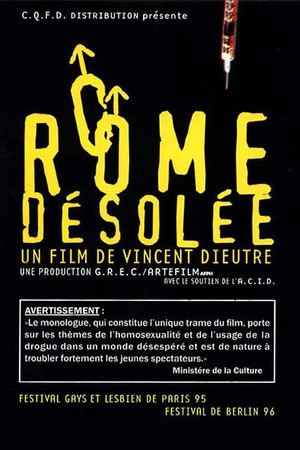
Chronicles of a male homosexual drug addict in 1980's in voice-over with long take scenes from Rome, television snippets of news of Gulf War and commercials.
A structuralist work composed of static, long-duration shots of Roman ruins and architectural details, all filmed on Super 8. The film operates without a traditional narrative or dialogue, relying on fixed compositions to document the interplay of light and shadow across ancient stone. By framing monuments through windows and doorways, Jean-Claude Rousseau explores the relationship between historical space and the act of observation.
Three women with Roma backgrounds each seek their own path to freedom and independence. Ruva was born deaf and fled Kosovo at a young age to escape the culture. Nadita was adopted as a baby and never knew her Serbian biological parents. Cillia lives according to the strict rules of traditional Sinti culture, which sometimes clash with her career as a dancer.
The film is separated into four chapters, each tracking a different group of protagonists who all have one thing in common – they were born deaf. Little Sandra likes to play football and admires Ronaldinho. Marián worships trains and wants to be an engine driver. Teenagers Alena and René are expecting a baby and long for it to be born healthy. The trio of Roman, Kristián and Karmen help their parents by collecting junk to be sold and dream of one day having a house with a flush toilet.
Chet Baker silently wanders through an Antonioniesque landscape in a Felliniesque state of wonderment as his improvised trumpet solos alternate between earnestly offering the obvious and mocking the artiness of the whole affair.
Going to the very heart of the Bible's most challenging Book, this one hour documentary decodes the visions of Revelation 12 and 17 for everyone to understand. Journeying from the birth of Christ through the Christian era, this amazing video pulls aside the veil of hidden history to reveal the rise of Babylon, the persecution of the bride of Christ, and the real-world identity of the beast. Educational and inspiring, Revelation delivers the keys to understanding the epic conflict between Christ and Satan and what it means for your life today.
Documentary examining the work of sculptor Richard Lippold, particular his sculpture of the sun at the Metropolitan Museum of Art.
At the peak of Perestroika, in 1987, in the village of Gorki, where Lenin spent his last years, after a long construction, the last and most grandiose museum of the Leader was opened. Soon after the opening, the ideology changed, and the flow of pilgrims gradually dried up. Despite this, the museum still works and the management is looking for ways to attract visitors. Faithful to the Lenin keepers of the museum as they can resist the onset of commercialization. The film tells about the modern life of this amazing museum-reserve and its employees.
Hungary was the site of serial murders on ethnic basis. Over the course of one year, the murderers killed and seriously injured Roma children and adults. The state charged 4 men with committing the crime with racial motivation. This historical trial started March, 2011, and ended August, 2013 in Budapest. The 167 days of hearings was only documented continuously by our crew. We had exclusive permission to use multiple cameras in the court-room. The film is a classical chamber-drama, taking place in a small, claustrophobic court room, in the middle of Europe. What will be the outcome of the marathon, 3 year-long trial?
How have the changing views on children been reflected in their representation in art? From Baby Jesus to the first photographic portraits, an exploration of six centuries of art history through the prism of childhood.
Alex Ritt, a music video director comes to Italy to direct a video for pop sensation Stefania Stella. He soon encounters a mysterious killer who videotapes his victims for the police. As the horrible murders continue, Ritt is unknowingly pushed into the killer's games and he soon becomes a target of the police. The video-killer is on the loose and Ritt must find out the truth before it's too late.
Decolonising the Curatorial Process is a forty-minute documentary which explores decolonial strategies in an academic and curatorial context. The film features academics, activists and practitioners, and contains case studies of institutions that are deploying critical, self-reflective forms of curatorial practice. The Museum of London Docklands exhibition on slavery and the sugar industry is examined as an example of how an institution can decolonise the curatorial process, utilise the work of artists in a museum context, and critically examine East London's imperial history. The Pitt Rivers museum in Oxford, who are working with Maasai activists from Kenya and Tanzania on a project centred on repatriating the museum's collection of sacred Maasai artefacts, also features in the film.
A portrait of five St. Petersburgians and their connection to The Hermitage.
What is true and what is false in the hideous stories spread about the controversial figure of the Roman emperor Gaius Julius Caesar Augustus Germanicus (12-41), nicknamed Caligula? Professor Mary Beard explains what is accurate and what is mythical in the historical accounts that portray him as an unbalanced despot. Was he a sadistic tyrant, as Roman historians have told, or perhaps the truth about him was manipulated because of political interests?
How the art in the Detroit Institute of Art connects to life's experiences and the neighborhood.
Francesco Borromini, génie du baroque romain
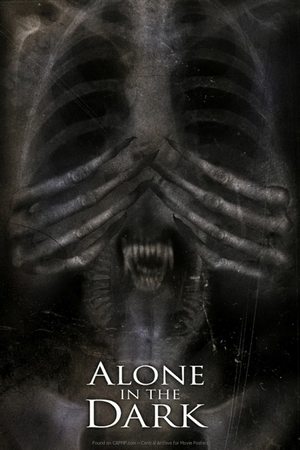
Edward Carnby is a private investigator specializing in unexplainable supernatural phenomena. His cases delve into the dark corners of the world, searching for truth in the occult remnants of ancient civilizations. Now, the greatest mystery of his past is about to become the most dangerous case he has ever faced.
After their car breaks down, a group of young travelers find themselves stranded at a roadside museum run by the enigmatic Mr. Slausen and populated by his collection of life-like wax mannequins.
A group of high schoolers decide to stay in a natural museum after closing hours, but a newly acquired and mysterious lamp hiding a deadly force will turn the fun into horror.
Originally produced in 1997 on the threshold of the Third Millennium of the Christian Era, and in celebration of the Jubilee of the Year of Our Lord 2000, The Vatican Museums was the culmination of three years of research and filming, the collaboration of thirty-two scholars and historians from around the world, a crew of forty directors of photography, operators, and lighting technicians, state-of-the-art digital cinematography, lighting, animation, and computerized editing, and the work of a famous composer with original performances by master musicians. Now available on DVD for the first time, this historic three-disc collection features seven hours of magnificent documentary film that illuminates and chronicles the great journey of the human spirit. Here then is the world's most spectacular and sacred repository of art, history, and faith.