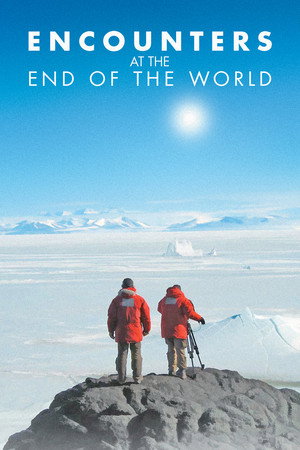
Herzog and cinematographer Peter Zeitlinger go to Antarctica to meet people who live and work there, and to capture footage of the continent's unique locations. Herzog's voiceover narration explains that his film will not be a typical Antarctica film about "fluffy penguins", but will explore the dreams of the people and the landscape.
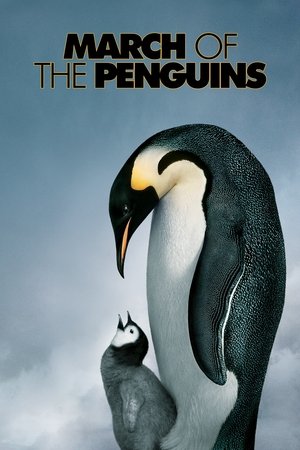
Every year, thousands of Antarctica's emperor penguins make an astonishing journey to breed their young. They walk, marching day and night in single file 70 miles into the darkest, driest and coldest continent on Earth. This amazing, true-life tale is touched with humour and alive with thrills. Breathtaking photography captures the transcendent beauty and staggering drama of devoted parent penguins who, in the fierce polar winter, take turns guarding their egg and trekking to the ocean in search of food. Predators hunt them, storms lash them. But the safety of their adorable chicks makes it all worthwhile. So follow the leader... to adventure!!
‘Voices from the Shadows’ shows the brave and sometimes heartrending stories of five ME patients and their carers, along with input from Dr Nigel Speight, Prof Leonard Jason and Prof Malcolm Hooper. These were filmed and edited between 2009 and 2011, by the brother and mother of an ME patient in the UK. It shows the devastating consequences that occur when patients are disbelieved and the illness is misunderstood. Severe and lasting relapse occurs when patients are given inappropriate psychological or behavioural management: management that ignores the severe amplification of symptoms that can be caused by increased physical or mental activity or exposure to stimuli, and by further infections. A belief in behavioural and psychological causes, particularly when ME becomes very severe and chronic, following mismanagement, is still taught to medical students and healthcare professionals in the UK. As a consequence, situations similar to those shown in the film continue to occur.
In southern Germany, winter can still be admired in all its glory every year. With its white coat of snow and icicles and myriads of small crystals that look like geometric works of art. In the valleys and on the slopes the snow is still so thick every year that the alpine huts are snowed in up to the windows. Cows and dairymen are safe in their farms at lower altitudes. But not the wild creatures of the mountains! They need strategies to survive the cold season and to defy snow masses, cold and ice. And some seem to do it so easily that they even raise their young in the middle of winter. But how do animals, plants and fungi cope with the annually recurring ice age, which from our perspective is a time of need? The many adaptations in nature prove that winter is an integral part of the natural cycle of the year and the living environment of species. They are adapted to cold and frost. That is why the animals and plants at the edge of the Alps suffer particularly from climate change!
The Priory is a public extended-care hospital in Victoria, British Columbia, for people suffering from chronic geriatric illnesses. Treatment is innovative. It is based on the theory that even the ordinary activities of a patient's life contain elements of therapy. The film shows us how patients are encouraged to do as much as they can for themselves despite their confinement to wheelchairs.
The ocean contains the history of all humanity. The sea holds all the voices of the earth and those that come from outer space. Water receives impetus from the stars and transmits it to living creatures. Water, the longest border in Chile, also holds the secret of two mysterious buttons which were found on its ocean floor. Chile, with its 2,670 miles of coastline and the largest archipelago in the world, presents a supernatural landscape. In it are volcanoes, mountains and glaciers. In it are the voices of the Patagonian Indigenous people, the first English sailors and also those of its political prisoners. Some say that water has memory. This film shows that it also has a voice.
As a winter storm approaches the shallow water crystallizes, ice builds up along the edges of a stream, and the first snowflakes of the storm layer over the newly formed ice. The following morning a soft light approaches through the snow covered forest.
It is winter at an emergency shelter for the homeless in Lausanne. Every night at the door of this little-known basement facility the same entry ritual takes place, resulting in confrontations which can sometimes turn violent. Those on duty at the shelter have the difficult task of “triaging the poor”: the women and children first, then the men. Although the total capacity at the shelter is 100, only 50 “chosen ones” will be admitted inside and granted a warm meal and a bed. The others know it will be a long night.
Recounted mostly through animation to protect his identity, Amin looks back over his past as a child refugee from Afghanistan as he grapples with a secret he’s kept hidden for 20 years.
The White Planet or in French, La Planète Blanche, is a 2006 documentary about the wildlife of the Arctic. It shows interactions between marine animals, birds and land animals, especially the polar bear, over a one year period. The fragility of the Arctic is hinted at as a reason to prevent climate change. It was nominated for the Documentary category in the 27th Genie Awards in 2007.
If you want to find world-class artisans, the small northern Labrador community of Hopedale offers you some of the best. Created through the St. John's International Women's Film Festival's FRAMED film education series, in partnership with the Nunatsiavut government, this film focuses on three prominent local craftspeople- two carvers and one traditional sewist.
On a sailboat in the middle of the Ocean, five teenagers in rehabilitation are travelling with adults of different ages and backgrounds. Off unknown coastlines, the boat’s space becomes a huis-clos in which everyone faces their own difficulties, the challenge of living together and also the manoeuvres of sailing, the Ocean and its turmoil—until the arrival on land.
Stan Hill Jr. is a Haudenosaunee artist living in Miawpukek First Nation Reserve, Conne River, Newfoundland. In “The Bear Inside a Whale,” he and his family discuss racism, identity, religion, creation and art, along with the cultural extinction of the Beothuk of Newfoundland. Throughout the film, we follow Stan carving a bear out of a whale vertebra. And we visit The Rooms (museum) in St. John’s, Newfoundland, where Stan talks about viewing and reclaiming Indigenous artefacts.
Inside the dramatic search for a cure to ME/CFS (Myalgic Encephalomyelitis/Chronic Fatigue Syndrome). 17 million people around the world suffer from what ME/CFS has been known as a mystery illness, delegated to the psychological realm, until now. A scientist in the only neuro immune institute in the world may have come up with the answer. An important human drama, plays out on the quest for the truth.
The beauty of the Arctic is breathtaking. For as long as we can remember, the Arctic has been associated with inhospitable cold. But the climate is changing, and with it the northern polar region, which begins beyond latitude 66.5 degrees north. Climate change is now happening four times faster north of the Arctic Circle than on the rest of the planet, making the future outlook dire. At the moment it is still possible for polar bears to raise their cubs, but hunting is becoming increasingly difficult on the drastically shrinking pack ice. The disappearance of the ice also affects the marine fauna. The wintry ice bridge between Canada and Greenland is threatened with collapse. The unstoppable melting of the permafrost, which has held the tundra together for thousands of years, is worrying. But the Arctic is still one of the wildest and loveliest regions on earth. A documentary visit to the Arctic - as long as it still exists.
An instructional film profiling the dragnet fishing technique as practiced by Danish sailors.
A documentary about young people with autism, and how arts and creative therapies help them to lead fuller lives.
Documentary on water usage, money, politics, the transformation of nature, and the growth of the American west, shown on PBS as a four-part miniseries.
CBC News Newfoundland Labrador's documentary entitled “Trail of the Caribou” traces the journey of the brave men of the Newfoundland Regiment. Created to mark the 100th anniversary of the Battle of Beaumont-Hamel, the movie gives a detailed account of the role the Regiment played in the First World War, putting faces to the story. Since the War, Caribou statutes were constructed in Europe to memorialize the significant places the Newfoundland Regiment fought. Trail of the Caribou transports the viewers to these places to trace the footsteps of the Newfoundland soldiers.
For almost a century and a half, Her Majesty's Ship Breadalbane lay wrecked and forgotten under the Arctic ice. In the spring of 1983, noted undersea explorer Dr. Joseph MacInnis led a team of twenty men on one of the most difficult, dangerous and unforgettable undersea adventures of the century--to put a diver on board the sunken vessel and recover some artifacts. This film, introduced by H.R.H. Prince Charles, provides a stunning visual account of this historic expedition.