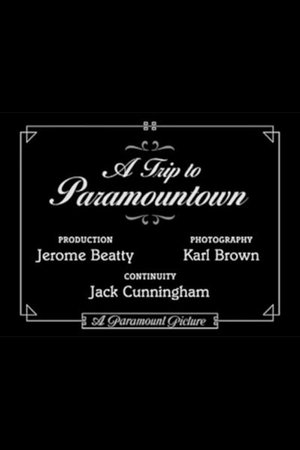
Documentary short film depicting the filmmaking activity at the Paramount Studios in Hollywood, featuring dozens of stars captured candidly and at work.
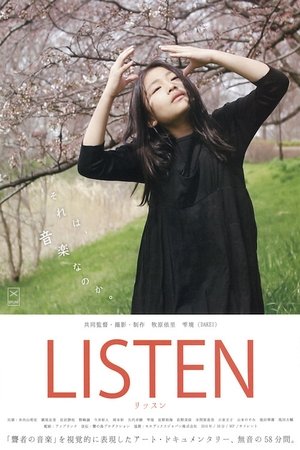
Documentary without audio produced by deaf people. Music is depicted visually with the complete absence of musical instruments or voices. Directed by Makihara Eri and choreographer Dakei. With a diverse lineup including ordinary deaf people with zero acting experience and a choreographer who performs in Japan and abroad, this film pulls out all the tops to give visual expression to music through the physical body. An aging man uses multiple sign language poems to convey the four seasons, and a girl expresses the wind amidst the rustling trees.
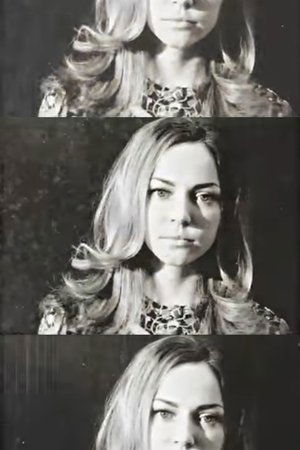
Andy Warhol directs The Factory regular Louisa "Jackie" Foster for a screen test.
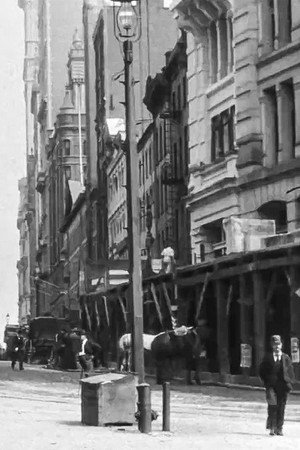
Taken in 1896 on the Boulevard (upper Broadway) on the occasion of a bicycle parade in the heyday of the wheeling craze. Old-fashioned horse cars lend interest to the scene.
Mudos testigos is a cinematographic collage made from all the surviving material of Colombian silent films, re-editing the images in such a way as to create a single imaginary film: the impossible love story of Efraín and Alicia that traces the convulsive first half of the twentieth century in Colombia. Compiled by the late Luis Ospina and finished posthumously by Jeronimo Atehortúa.
Watch as Aiden Aleman creates his newest art piece “TRUTH” in the middle of Zilker Park.
Documentary that details the daily habits of beavers and their interaction with the ecosystem at large. Filmed mostly in Digby County, Nova Scotia.
Peter Hutton's New York trilogy. An act of urban archaeology, a chronicle of indelible impressions of the city.
This silent film from 1948 "The Creation of Life" briefly demonstrates how a fetus forms and graphically shows different types of births. It was made by Sherwood Picture Corp., and may have been sold both to schools and professional organizations for medical education, and to the public for shock value. (Several similar birth films were sold in this era through home catalogs and photography shops.) Summary: By means of diagrams, conceptions and pregnancy are explained. Views of various methods of delivery are shown. Created by: T. Marc Sherwood
"Scenes from their (Guilherme and Lia Torá's) tests in Brazil, others taken at Paulo Benedetti's studio and garden, some excerpts from footage in which they are not present, excerpts from the 'formidable' reception in New York and natural scenes: of trains and Fifth Avenue." (Cinearte, 07.03.1929)
Six years after the Berlin Wall fell and five years after German unification this documentary looks into the fast changes in architecture and street life of Berlin Mitte and stays in tune with a piano piece of Ludwig van Beethoven.
Shows masked mental patients enacting various schizophrenic symptoms as they were understood at the time. A disturbing film that raises questions about the condition and treatment of its subjects. (archive.org) “Abstract: This film describes and demonstrates four types of schizophrenia. Filmed at various New York institutions, it shows patients singly and grouped in large, outside recreational areas. Some patients are blindfolded. Symptoms shown include: social apathy, delusions, hallucinations, hebephrenic reactions, cerea flexibilitas, rigidity, motor stereotypes, posturing, and echopraxia.” (Guide to Mental Health Motion Pictures)
On September 11, 1929, the first Termez-Dushanbe train arrived at the newly built station in the Tajik capital. However, not only the train was the first that day - the shots of the arrival of the locomotive, as well as people waiting for it with excitement, became the basis of the first Tajik film.
24
Exploring the Anthropocene era characterized by human impact on the planet, this is an enlightening VR film that examines an emerging superpower undergoing mass urbanization, industrial development, and topographical changes.
Farm work and nature.
Elam records several men moving boxes and furniture as they track across her backyard.
Register of the events which occurred between 9 and 15 April 1948 in Bogota as a result of the assassination of political leader Jorge Eliécer Gaitán
Florence is a contemplative study of light and shadows, textures and planes, that makes beautiful use of the tonal qualities of black and white film. (mubi.com)
This footage is almost entirely black, save for a few shots possibly showing electric poles outside.