JDM Insider
Le Japon, l'empereur et l'armée
Takeshi Kitano is an international icon. We know the actor, the multi-award-winning filmmaker, but many ignore his double personality: the crazy TV star, the street kid from Tokyo close to the Yakuza, and the political satirist who blasted taboos! Can we dream of a better guide to introduce us to the cultural history of Japan?
This Traveltalk series short looks at pre-World War II Tokyo, highlighting the influences of Western culture.
Filmmaker Ian Taylor examines the impressive legacy of Hong Kong cinema -- specifically, how martial arts crossed borders and become an international phenomenon -- with the help of footage and interviews with the stars who made the genre what it is today. Director Lau Ka Leung (who helmed The 36th Chamber of Shaolin) joins in, sharing his thoughts on how certain cinematic technologies have improved martial arts films and expanded their appeal, on the set of Drunken Monkey (2003).
'Peng! Snowman' is a feature length documentary about a farmer's son who became one of the worldwide best martial artists. Just forget what you know about martial arts master. Peng will redefine the term: He's a funny, crazy genius! At the age of 60, Peng Wu-Chi was willing to share his incredible story for the first and last time - before he disappeared.
The complete "Understanding Qigong" series by Dr. Yang, Jwing-Ming. Learn how and why Qigong works to increase your energy and improve your circulation. The Chinese word Qigong means 'energy work'. Qigong is the ancient art of using the mind to naturally develop the body's Qi (energy) for improved health and longevity. Dr. Yang's systematic approach to teaching offers deep insight into the subject of Qigong with modern scientific data to support his theory from both an Eastern and Western perspective.
Violinist and songwriter Kishi Bashi travels on a musical journey to understand WWII era Japanese Incarceration, assimilation, and what it means to be a minority in America today.
After decades of living a secret life, a filmmaker travels to a strict Japanese monastery in search of guidance but the only monk willing to help him prefers ice cream and heavy metal over meditation. CROWS ARE WHITE is an exploration of truth, faith and love, from the top of a mountain to the bottom of a sundae.
The life of Fumio Demura, the greatest karate master of a generation.
Untangling the web of cultural and historical ties underlying Japan's deep fascination with insects.
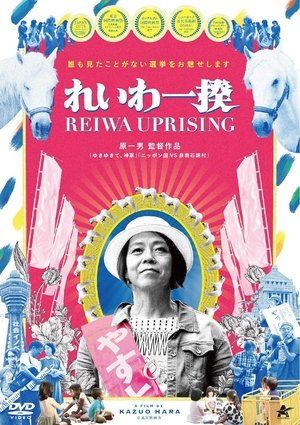
Can a candidate with no political experience and no charisma win an election if he is backed by the political giant Prime Minister Koizumi and his Liberal Democratic Party? This cinema-verite documentary closely follows a heated election campaign in Kawasaki, Japan, revealing the true nature of "democracy."
An independent crowd-funded documentary that celebrates the sixty-year legacy of the world's greatest monster, Godzilla. Filmed on location in Tokyo to document kaiju-related events, locations and to interview cast, crew and fans of the Godzilla series about their passion and experiences with the King of the Monsters.
This documentary is set in the New Marilyn night club in Tokyo, Japan - where the hosts are transgender men. They can only make their living as hosts in a nightclub with other wannabes like them. The young women who come there often have relationships with them but the underlying fear is whether such a relationship can withstand the pressures on a girl to get married and have children. All three boys deal with this in different ways. These three hosts, the Shinjuku Boys, take us into their lives.
Dear Pyongyang is a documentary film by Zainichi Korean director Yang Yong-hi (Korean: 양영희, Hanja: 梁英姬) about her own family. It was shot in Osaka Japan (Yang's hometown) and Pyongyang, North Korea, In the 1970s, Yang's father, an ardent communist and leader of the pro-North movement in Japan, sent his three sons from Japan to North Korea under a repatriation campaign sponsored by ethnic activist organisation and de facto North Korean embassy Chongryon; as the only daughter, Yang herself remained in Japan. However, as the economic situation in the North deteriorated, the brothers became increasingly dependent for survival on the care packages sent by their parents. The film shows Yang's visits to her brothers in Pyongyang, as well as conversations with her father about his ideological faith and his regrets over breaking up his family.
A filmmaker plays with diary-docu and fiction as his camera joins his ventures into a phone dating club. Bored to death, hormones running, and desperately wanting to talk to someone his own age (preferably a girl), he walks into a local phone dating club. Can he hook up with someone? Borrowing the form of a diary-movie, the director unfurls an unpredictable and imaginative look into his own persona. 8mm experimental film by Murakami Kenji, the film that made his name.
In the final hours of the Pacific War, Okinawa was the destination for Korean men conscripted as “military laborers” and Korean women taken as “comfort women.” Little is known about the number of casualties or their experiences. In 1989, Park Soonam started to track down the survivors of the Battle of Okinawa to record their testimonies. In 1990, Park visits Korea in search of former “military laborers” who had survived Okinawa and repatriated to Korea. The survivors vividly recount their experiences of their compatriots’ murder and about the “comfort women” to the Zainichi Korean female director. The film zeroes in on the murder of Korean “military laborers” and the presence of “comfort women” in Okinawa via testimonies of former Japanese soldiers.
Katanas, yakuzas y cintas de video
In June 1942, Japanese bombers tried to level the American presence on Midway Island in a bid to steam unimpeded toward the U.S. mainland. Yet the U.S. Navy had two aces up its sleeve: advance knowledge of Japanese plans and a dive-bomber that was nearly invulnerable to attack. When the smoke cleared after the U.S. ambush, four Japanese aircraft carriers -- the Kaga, the Soryu, the Hiryu and the Akagi -- lay on the ocean floor. The program shows how the U.S. Navy and private enterprise teamed up on a 1999 expedition that solved a half-century of military mystery: where exactly did the Japanese ships go down?
Founded in Tokyo in the aftermath of WWII, Naito Auto Engineering is a three-generation family business, renown for restoring high-value classic cars with artistry and precision. Masao Naito, with his bold vision and rebellious spirit, took his father's local mechanic shop and turned it into a first-class company, whose services are coveted by top auto collectors the world over. For over 40 years, Masao has ruled the family business with an iron fist. Now, with his retirement on the horizon, cracks are beginning to show. Do the younger Naitos have what it takes to keep the family together, and carry the business forward?