Aoluguya, Aoluguya is the first film in Gu Tao’s Ewenki Trilogy. A tale that unfolds in the Aoluguya forest, featuring such unique characters as a mother who dulls her sadness over the absence of her son, Yuguo, with alcohol; her brother; and Maria, the tribal chieftain who watches over them.
Hyacinthine Scar condenses the undigested emotions in me while traveling from Hong Kong to my brother’s wedding in Guam. Presences and gazes of all sorts, to look and to be looked at, repetitive camera work of the hired videographers, the vow that is rehearsed over and over again by the priest, all the uncontrollable clickings of the shutter from all us (including myself), and the endless sightings of different sides of the fragmented Western Pacific. The many spots I visited appear as though they belong to passersby. They are as real as they are dreamy.
In the summer of 2007, Gan Xiaoer led an independent film projection team, using projectors and self-made screens, to tour villages in Henan province to show his feature film "Raised from dust" for 8 times, and recorded the process. The 81-minute version of Church Cinema records only one stop, the Qiliying Church, where "Raised from dust" was shot.
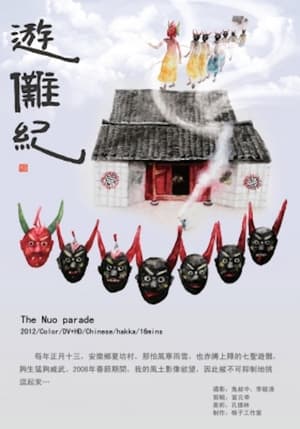
Hakka, a special and little-known ethnic group in Hainan, is a branch of the Chinese Hakka system that has been neglected. They are far from the mainland, and they are rarely mentioned. The relatively closed environment has allowed the Central Plains culture to be completely preserved. After that, it has formed a special change with the ethnic minorities such as Li Miao. However, this unique traditional culture is now fading away in the erosion of modern civilization.
The story took place in 2008. Henan Guo Hui, who was a harvester, went to the provinces to harvest wheat for him. He and his father then invited a driver and set off. I went to Shanxi, Shaanxi, and also included Henan. They met other mairs to talk about the earthquake in Sichuan and talk about the difficulties of collecting wheat. Bargaining with the farmers, thinking of the law less to give the leader a little commission, sometimes to think of the way to get money, sometimes to think of ways to escape the control of the leader. The driver complained that the car owner was too bad, and the owner complained that the driver had eaten too much. In the middle of the road, I also encountered the need to collect the toll, and finally met the young and confused.
July 27th, 1976 - a day the people of Tangshan will never forget. When that fateful day ended, tens of thousands had been killed, and the lives of the survivors would be changed forever. No public official, no expert, nor anyone among the seismological personnel - regardless of what they were doing that day - should ever forget. History will always remember the twilight of that day.
"China Gate" tells the story of young Chinese fight to change their fate through studying. Right before dawn, students in Huining have already started their self-studying session; hard working youngsters have filled up the space of school ground. This is one of the most poverty-stricken Counties in Western China; here people's only hope is in education, as the way to change their social status. Therefore all their effort point towards the College Entrance Examination, the process is like going through a gate, those who pass can study at urban Universities, and have the chance to build a better life. During the same winter season in Beijing, a graduate student faces a big decision. Should he keep trying to survive in the big city or get back to his countryside home? The exhausted faces at the Beijing underground seem to be revealing the truth about their distance in between. The student comes to see the flag ceremony at Tiananmen Square, where the pulsing symbol of the nation lies.
Don't forget to have poetry when making a living. This is romance. Even if you live in a sheepfold, you have a holy smile like a baby. This is romance. Listening to folk songs from the workers' hometown at the construction site in Shenzhen is touching. Once the song stops, you become eager for it. This singing series is also called "Sharing Hometown" and “Lingering Songs". You see, the eyes of the singing workers are shining, because we are all close to the Buddha.
Two families' oral history of the Cultural Revolution and their current life.
The Check Fun Store is an innovative business model. Every store is divided into hundreds of small checks to display and sell a wide range of creative products provided by people who rent these checks. Thanks to its risk diversification nature, the Check Fun Store business model proliferated in Taiwan when the financial crisis hit in 2007 to carry people through the global economic downturn.
The documentary film, The Road, reveals the status of 22 students who study in a private village school in Hunan Province. Through in-depth interviews, the inner world of these “left-behind children” who are lack of parental love has been explored. We hope that through this film, we could hear the responses and actions from our society.
Daqi Village is located in Shichao Township, Wuchuan Gelao and Miao Autonomous County, Zunyi City, Guizhou Province. The village has 985 households with 4119 people, including 435 households with 1803 persons. It is one of the 2,760 deeply impoverished villages in Guizhou Province.
For the dream of music, Pan, the folk singer, left home for Guangzhou. Two years ago, he released his first album, 《Hi, Pan》. The ideal life seems to be closer and closer for Pan. However, as time goes by, his thoughts have changed gradually. Music is not just as simple as music.
Village Diary
In 1978 Deng Xiaoping set up Shenzhen as a Special Economic Zone in China, and this decision led to the rapid development of Guangdong economy. Numerous factories have been established, millions of people are attracted because of gold rush. Over 30 years later, young people who were away from their home have already stepped in the midlife. Guangdong has become a representative of job hunting and has been drawing a newly young generation who has faith and uncertainty to the future. This video revolves around three working-class boys who are the 90s generation.
Yulin, once the poorest region of Northwest China, has rapidly become "China's Kuwait" for the mining industry launched in recent years. People rush into the coal mine and other coal-related businesses, hoping to get rich overnight. They are possessed by anxiety and restlessness. However, it seems they have no other choices…
In northern Shaanxi, those three-wheeled trucks who came to the city from rural areas came to be suffering. They talked hard and finally sent their children to distant universities. Four years have passed, the big children can't find a job, the future is uncertain, the smaller children have come to the age of the university. It seems to be in the instinct, a family is still like a hen hatch, waiting for the new hope to break out.
Li Songshan, a disabled poet in Lilou Village, Henan Province He lived with sheep every day and gave himself a pen name -- Goateed. Film explores the wonderful intertext between the poetic world of goatee and real life through an award-winning journey and the people around him.
Different veterans, different memories of the Anti-Japanese War, and different lives. The oral narratives of 7 veterans show you the pictures of the Anti-Japanese War in that year, and take you to understand the current situation of the veterans of the Anti-Japanese War in Guangdong.
Class 172 is a key class for their excellent students of an ordinary secondary school in Hunan province, from which the kids’ main goal is to upgrade into one of the best province-level high school – No.1 high school of the county. In the recent few years, the school’s enrollment rate to high school was not quite satisfying, and this year, the newly promoted class in charge teacher – Mr. Xiang, who’s only graduated a few years ago, became their brightest hope to teach the students and raise the enrollment rate for school.