At the beginning of the twenty-first century, abstraction - that most quintessentially modernist innovation - maintains a peculiarly contradictory position. Used, on one hand, by post-modernist artists as just one more quotable style amongst many, it is on the other hand still considered an elitist or hermetic language by audiences intimidated by its lack of recognizable subject matter. Yet ultimately, abstraction continues to be a viable creative path for contemporary artists of all generations, many of whom embrace it as the most inclusive and fundamentally resonant of artistic languages. Filmed at the artists' studios, the Dia Center for the Arts, and the Guggenheim Museum during their exhibition, "Abstraction in the Twentieth Century."
An abstract perspective into two young South African workers in the heart of Johannesburg's industrial sector during Covid-19
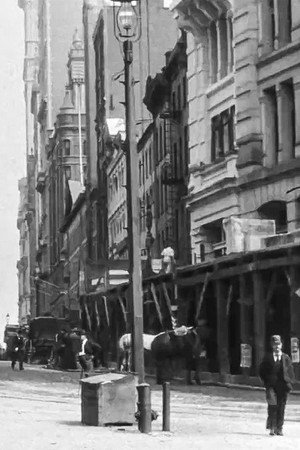
Taken in 1896 on the Boulevard (upper Broadway) on the occasion of a bicycle parade in the heyday of the wheeling craze. Old-fashioned horse cars lend interest to the scene.
Documentary short film depicting the filmmaking activity at the Paramount Studios in Hollywood, featuring dozens of stars captured candidly and at work.
An exploration of Rodez Cathedral and its stained glass windows: praying figures and scientific imagery. A study on color, repetition and flickering consisting of 292 photographs.
A condensation of a handful of sunsets with various visual moods. Red and blue as opposites that still find a way to cohere. Concrete silhouettes over an ever-changing, expanding canvas. Every movement is collective, molecular. Over an invisible horizon, a chance presents itself to meditate on the “speed” of water (and the sea) and also for a more fluid kind of editing.
Documentary that details the daily habits of beavers and their interaction with the ecosystem at large. Filmed mostly in Digby County, Nova Scotia.
An abstract and detailed observation of a young life told through a series of observational montages. Part of the 'Technicolour' series of films from Lot 108 Productions.
This silent film from 1948 "The Creation of Life" briefly demonstrates how a fetus forms and graphically shows different types of births. It was made by Sherwood Picture Corp., and may have been sold both to schools and professional organizations for medical education, and to the public for shock value. (Several similar birth films were sold in this era through home catalogs and photography shops.) Summary: By means of diagrams, conceptions and pregnancy are explained. Views of various methods of delivery are shown. Created by: T. Marc Sherwood
Mudos testigos is a cinematographic collage made from all the surviving material of Colombian silent films, re-editing the images in such a way as to create a single imaginary film: the impossible love story of Efraín and Alicia that traces the convulsive first half of the twentieth century in Colombia. Compiled by the late Luis Ospina and finished posthumously by Jeronimo Atehortúa.
Amongst the contemplative static shots of decaying architecture weaves an abstract narrative unveiling the life-cycle of a higher perception, too large to perceive. Shot at various sites across south-east England, INFRASTRATA is a study on the concept of super-organisms, and the relationship between structure and nature.
Watch as Aiden Aleman creates his newest art piece “TRUTH” in the middle of Zilker Park.
Peter Hutton's New York trilogy. An act of urban archaeology, a chronicle of indelible impressions of the city.
A Experimental Docu-Drama about the Red Army Faction's formation, and events leading up to their imprisonment and death, from 1970 to 1977.
This short film from Arthur Lipsett is an abstract collage of snippets from discarded footage found by Lipsett in the editing room of the National Film Board (where he worked as an animator), combined with his own black and white 16mm footage shot on the streets of Montreal and New York City, among other locations. A commentary on a machine-dominated society, it is often cited as an influence on George Lucas's Star Wars and his conceptualization of "The Force."
Building on testimony from pro-Palestinian activists in Berlin and featuring demonstration footage from between 2023 and 2025, this animated documentary explores activist culture and the people who have spent the past 2 years clashing with German police. By applying an expressive and colourful brush stroke to the experiences and anecdotes of two people closely involved with the movement, we look into the motivations that have driven them to get involved and their reactions to the repression they have experienced. Staatsraison attempts to shine light on police violence and explore how repression can drive someone ever further into a political movement.
Andy Warhol directs The Factory regular Louisa "Jackie" Foster for a screen test.
On September 11, 1929, the first Termez-Dushanbe train arrived at the newly built station in the Tajik capital. However, not only the train was the first that day - the shots of the arrival of the locomotive, as well as people waiting for it with excitement, became the basis of the first Tajik film.
"This is taking a Super 8mm camera around with me wherever I go and I'm very interested in windows at this time of travel, and I'm trying to make a variety of different statements about the concept of window." - S.B.
Shows masked mental patients enacting various schizophrenic symptoms as they were understood at the time. A disturbing film that raises questions about the condition and treatment of its subjects. (archive.org) “Abstract: This film describes and demonstrates four types of schizophrenia. Filmed at various New York institutions, it shows patients singly and grouped in large, outside recreational areas. Some patients are blindfolded. Symptoms shown include: social apathy, delusions, hallucinations, hebephrenic reactions, cerea flexibilitas, rigidity, motor stereotypes, posturing, and echopraxia.” (Guide to Mental Health Motion Pictures)