160 meters is the distance between the two banks of the estuary of Bilbao. An economic, social and cultural approach at two ways of looking at life.
The chronicle of the process, ten long years, that led to the end of ETA (Euskadi Ta Askatasuna), a Basque terrorist gang that perpetrated robberies, kidnappings and murders in Spain and the French Basque Country for more than fifty years. Almost 1,000 people died, but others are still alive to tell the story of how the nightmare finally ended.
Vitoria, marzo de 1976
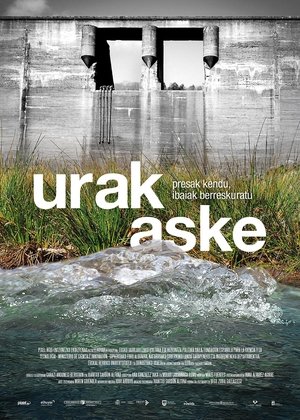
Draining two million cubic meters of water to protect a small animal in danger of extinction. This has been the task of those who have worked to remove the Enobieta reservoir and ensure a safe haven for the Pyrenean desman. This amazing story took place in Artikutza, the estate that San Sebastián bought in Navarre a century ago and which is now one of the best-preserved natural sites on the Cantabrian coast. In Normandy, meanwhile, the large Vezins dam has been removed. Its demolition will allow salmon to return to the Sélune River. Abandoned dams on rivers are barriers to biodiversity, and their demolition allows us to imagine a more habitable planet. That future will depend on small gestures, or large ones, such as those in Vezins and Enobia.
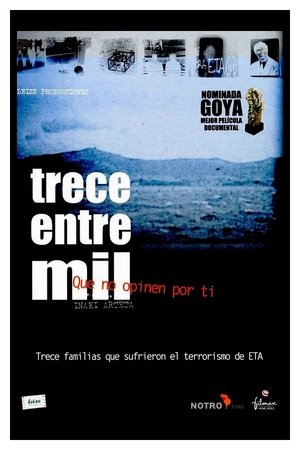
The history of the citizens' movement that for thirty years worked hard to overcome fear, fight hatred and eradicate the violence exercised by the savage terrorist gang ETA, both in the Basque Country and in the rest of Spain.
Utopías y otras especies
An attempt to create a bridge between the different political positions that coexist, sometimes violently, in the Basque Country, in northern Spain.
Pilot chapter of the film series 'Ikuska', a compilation of shorts on the Basque Country’s culture and politics. A documentary about the referendum on the Spanish constitution.
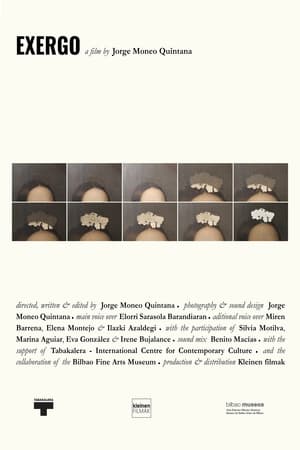
Departing from peripheral details of some paintings of the Bilbao Fine Arts Museum, a female narrator unravels several stories related to the economic, social and psychological conditions of past and current artists.
Spanish police killed four members of the Autonomous Anticapitalist Commandos in 1985. This documentary provides a narration of the murder that the State of Spain has tried to hide. There are several testimonies of family members, witnesses and experts.
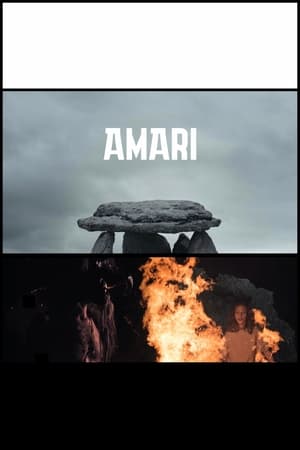
A documentary, filmed entirely in the Basque Country, about Basque mythology and the ancestral beliefs of its people. Created by writer Toti Martínez de Lezea and anthropologist Anuntxi Arana, Amari immerses us in a world of legends full of supernatural beings that formed and continue to form part of the Basque people's imagination.
The film follows five people from different origins as they move anonymously around the streets of Berlin. Each of them with another life somewhere else, trying to ascertain where to go.
In 1942, in the midst of World War II, Nazi Germany occupied France. The Resistance launched numerous escape networks to help people escape from Nazi to the allied Europe. Among them there was the network of escapes that acted in secret between Mendibe-Orbaizeta, a network so secret that it did not even have a name. Spies, clandestine networks, smuggling, solidarity, resistance, hope... All this and more is the documentary 'Sans nom sarea' (Sans Nom Network).
The massacre occurred 500 years ago. In 1525, the Spanish Royal Council ordered the execution of five members of a cult recently discovered in the Pyrenees. This event marked the beginning of a relentless, century-long prosecution against Basque witchcraft, which exhibited all the hallmarks of the great European witch hunts, including an unstable border between powerful nations, revolts against the lords, raging misogyny, confessions obtained under torture, and mass accusations. These past five centuries, only one account has been heard: that of the inquisitors and jurists, the same ones who invented the myth of flying witches who met with the devil at sabbats to plot their crimes.
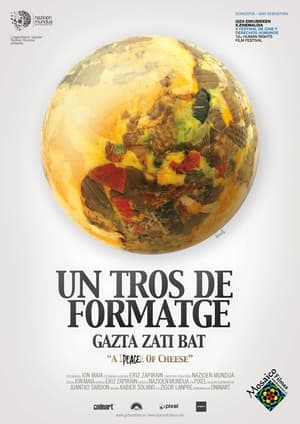
This story begins in a small town in Euskal Herria known worldwide for its cheese. The inhabitants of this town put aside the differences created by the recent armed conflict in Europe to carry out a mission: to choose what to be in the world. This adventure will take them to witness the historic events of two nations that will be news in Europe: Scotland and Euskal Herria. A great story written in small print. A documentary of the new era that makes us look to the future
In a temple in Thailand, an order of Buddhist monks are performing a ceremony for people who headed there to get re-incarnated. There, we meet Tarn, a young Thai woman who lived in the Basque Country some years ago and who is still fascinated with that region, food and culture.
Documentary about anchovy fishermen in San Sebastian
Not unlike the travel blogs so in vogue today, this film takes us from Ereaga beach to Cape Matxitxako, treating us to an incomparable look at the beaches and towns on the way.
A peculiar in-depth reflection on the concept of homeland reflecting the atmosphere of Basque farmhouses with the participation of emblematic figures in the Basque culture of the period, like the bertsolaris (improvisers of Basque verse) Valentin Enbeita and Jon Lopategi and the Basque dancer Victor Olaeta. To avoid the censorship in place at the time, Elortza entitled the film 'Erria' (Country) rather than 'Aberria' (Homeland).
"Look for the part that's missing from this book; there, somewhere in your house it's kept. I've tried to walk as far as halfway between you and I; I can't carry on. The respect I bear for what's yours does not let me go any further", Joxean Artze.