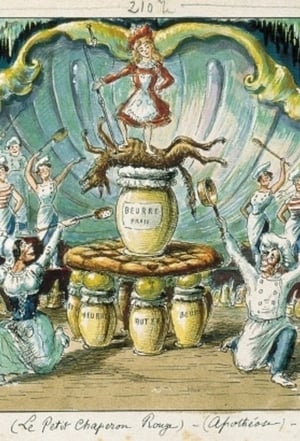
In a bakery in the French countryside, Father Latourte, his wife, and their staff are busy with customers, pastries, and baked goods of all kinds. The Latourtes' young daughter, called Red Riding Hood, reads by the firelight until her parents leave for a moment. She starts to play boisterously, getting the bakery staff mixed up in hijinks and pratfalls. Her father and mother return, chagrined by her escapades, and she is told to take a pot of butter and a galette to her grandmother's cottage. Red Riding Hood travels through the forest on her errand, meeting a wolf, who finds out where she is going. Encountering her friends from the village school, she happily pauses her journey to play and dance with them. Meanwhile, at a windmill near the cottage, the miller Sans-Souci has comic trouble with his mule.
Hajj, a rascally beggar on the periphery of the court of Baghdad, schemes to marry his daughter to royalty and to win the heart of the queen of the castle himself. This film is believed lost.
Oiwa Inari
One of the two earliest horror films ever made. This film is presumed lost.
One of the two earliest horror films ever made. This film is presumed lost. In this black comedy scene, the bottom falls out of a coffin, the corpse tumble out, and is jolted back to life. Short sequences like this, as well as street scenes and dancing geisha girls were the main subjects of early Nippon cinema, pioneered by Shiro Asano and Shibata Tsunekichi from 1897 onwards. In creating dramatic, scenes, film-makers naturally chose the most striking or bizarre. Another undocumented film, recalled by cameraman Shiro Asano.
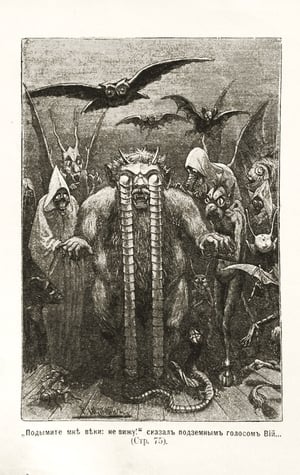
Based on a the horror novella of the same name. First Russian horror film.
Earliest japanese horror film.
Yotsuya Kaidan
Shin Yotsuya Kaidan
Yotsuya Kaidan (Jitsoroku Oiwa)
May Night, or the Drowned Maiden
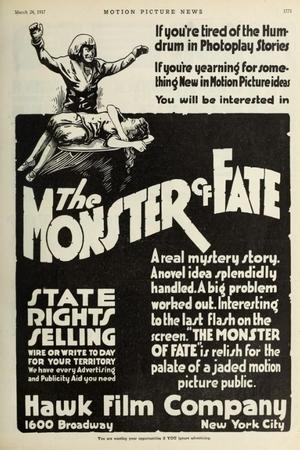
Nailed
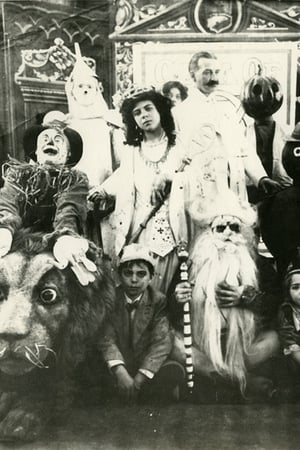
L. Frank Baum would appear in a white suit and present his live actors, slide shows and films as a live travelogue presentation of his popular fantasies. Highlights include Dorothy being swept to Oz in various ways, such as with back-projection tornadoes and storms in a chicken coop. Lack of financial backing forced the show to fold after appearing in only two cities, despite being a critical and commercial success. This film is lost.
A period fantasy that told of the ageing king of Kamarpur, and his two rival queens, Navbahar and Dilbahar, and their rivalry when a fakir predicts that Navbahar will bear the king's heir. Dilbahar unsuccessfully tries to seduce the army chief Adil (Vithal) and vengefully destroys his family, leaving his daughter Alam Ara (Zubeida) to be raised by nomads. Eventually, Alam Ara's nomad friends invade the palace, expose Dilbahar's schemes, release Adil from the dungeon and she marries the prince of the realm.
This mostly lost film is often confused with director Paul Wegener third and readily available interpretation of the legend; Der Golem, wie er in die Welt kam (1920). In this version of the golem legend, the golem, a clay statue brought to life by Rabbi Loew in 16th century Prague to save the Jews from the ongoing brutal persecution by the city's rulers, is found in the rubble of an old synagogue in the 20th century. Brought to life by an antique dealer, the golem is used as a menial servant. Eventually falling in love with the dealer's wife, it goes on a murderous rampage when its love for her goes unanswered.
A vengeful antique dealer targets a dancer.
An abandoned baby is saved by a river god. Now aged 20, she yearns to see the world outside the water.
The first talkie from the Philippines.
A miser dies of shock when the ghost of a poor woman appears.