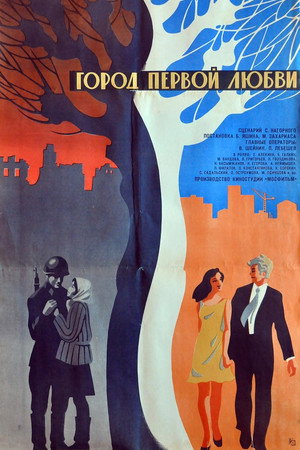
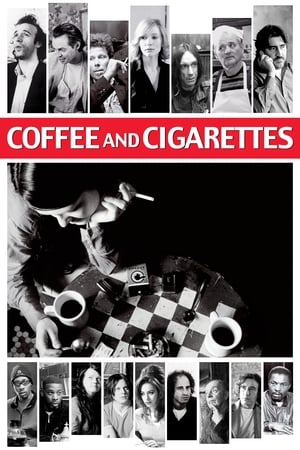
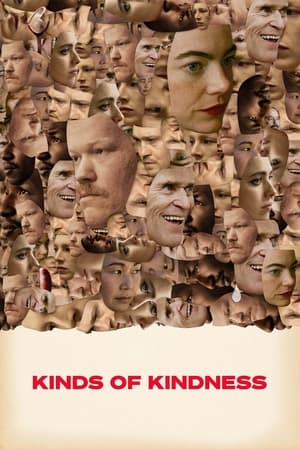
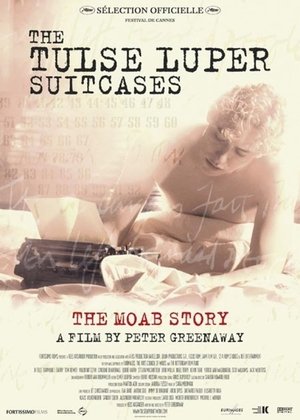
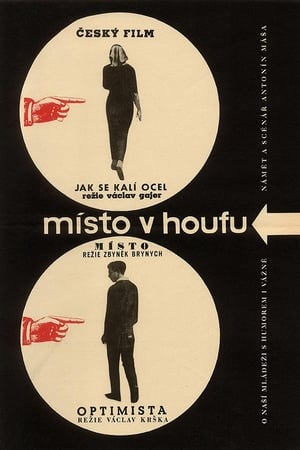
Jurácek's feature debut is shot in two parts. In the first, a corporal accompanies a new recruit with a sore Achilles tendon for his physical, and all the girls or young women they see are played by the same actress (Ruzickova). In the longer second segment, shot with the help of the Czechoslovakia army, the soldiers pass the time during basic training and maneuvers by talking about girls.
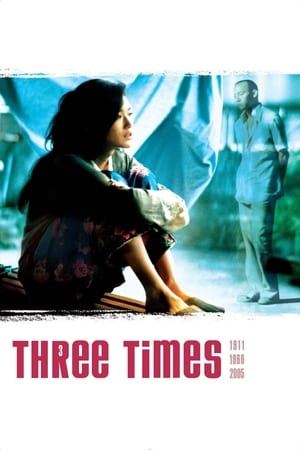
In three separate segments, set respectively in 1966, 1911, and 2005, three love stories unfold between three sets of characters, under three different periods of Taiwanese history and governance.
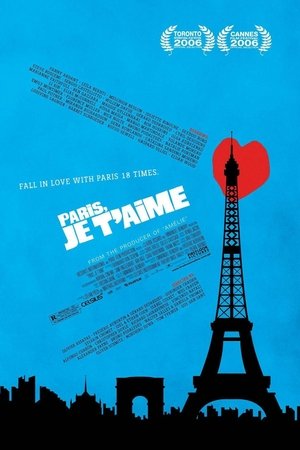
New York, I Love You delves into the intimate lives of New Yorkers as they grapple with, delight in and search for love. Journey from the Diamond District in the heart of Manhattan, through Chinatown and the Upper East Side, towards the Village, into Tribeca, and Brooklyn as lovers of all ages try to find romance in the Big Apple.
Eight visually rich vignettes drawn from Kurosawa’s own dreams—fox weddings and vanished orchards, a soldier’s ghosts, a walk through Van Gogh’s canvases, nuclear nightmares, and a water-mill utopia—meditate on childhood, art, mortality, and humanity’s uneasy bond with nature.
Obsession
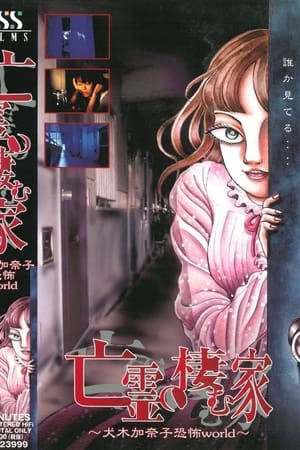
A two-part feature directed separately by Shimizu and his colleague Keisuke Toyoshima. Unrelated to each other, both have a common goal: to bring ghosts and aliens together in pure, referential and absurdistic delirium, including neo-Nazi specters, zombie yakuzas and nasty aliens.
Five O. Henry stories, each separate. The primary one from the critics' acclaim was "The Cop and the Anthem". Soapy tells fellow bum Horace that he is going to get arrested so he can spend the winter in a nice jail cell. He fails. He can't even accost a woman; she turns out to be a streetwalker. The other stories are "The Clarion Call", "The Last Leaf", "The Ransom of Red Chief", and "The Gift of the Magi".
The lives of six individuals across the city change just as the city is reeling under floods. Will they all make it safely to the other side?
Queer Boys and Girls on the Shinkansen brings together ten filmmakers and artists who consistently affirm what it means to be gay or lesbian in their work. Habakari chose ten filmmakers to make a five-minute work each, developed around a gay or lesbian theme, and compiled the resulting shorts in random order to create this omnibus film. The result is a queer film, by queer filmmakers, for a queer audience. Each short is its own short story, and the styles range from drama and experimental film and animation. (2024 complete version includes all eleven films, 65 mins.)
A three-part anthology about love and sexuality: a menage-a-trois between a couple and a young woman on the coast of Tuscany; an advertising executive under enormous pressure at work, who, during visits to his psychiatrist, is pulled to delve into the possible reasons why his stress seems to manifest itself in a recurring erotic dream; a story of unrequited love about a beautiful, 1960s high-end call girl in an impossible affair with her young tailor.
A daughter struggles to speak with her father about her grandmother, revealing the quiet distances — and shared inheritances — that shape three generations of family.
Nanni Moretti recalls in his diary three slice of life stories characterized by a sharply ironic look: in the first one he wanders through a deserted Rome, in the second he visits a reclusive friend on an island, and in the last he has to grapple with an unknown illness.
Based on four of the six short stories compiled in Murakami Haruki's anthology, After the Quake explores the complex aftermath of Japan’s earthquakes and other global crises. (Movie version of the TV drama).
A young and excentric radio DJ airs a successful program in which diverse calls come in from anonymous listeners, who reveal their love stories, all charged with mix-ups, disputes and passion.
Five stories center on a werewolf, a feudal landlord, peasants, a ghost, and a mother and her sons.
An anthology of one-minute films created by 51 international filmmakers on the theme of the death of cinema. Intended as an ode to 35mm, the film was screened one time only on a purpose-built 20x12 meter public cinema screen in the Port of Tallinn, Estonia, on 22 December 2011. A special projector was constructed for the event which allowed the actual filmstrip to be burnt at the same time as the film was shown.
Wasteland is a five-part anthology film that deals with isolation, mental illness, and the subjectivity of reality. Each of the five parts can be watched individually, but when viewed in sequence, each story brings out a more interesting and distinct context to its respective pieces.
Ep.01 My wife's healing Yumi and Hyun-tae are on a journey of reconciliation overnight to overcome bourgeoisie. Eating dinner together I'm going to join the couple who stayed in the next room. Jae-yong informs Lee Hyun-tae that he can overcome boredom ... Ep.02 Soap Scent Eun-su, who was tired of her boyfriend, told a Chinese housekeeper I am at a glance, and both of them cross over the lines I should not cross ... EP.03 Singularity Family The family of Sehun, who is reconciled with other family members, enjoys each other's private life in the evening. Sehun went to the bathroom in the middle of the night and witnessed a scene he could not imagine Sehun himself confesses his family to the absurd fact ...
An omnibus film that tells the story of AI's that resemble humans coexisting with humans in the near future of Korea.
What is “Slovakia”? How to explain the notion of “Slovakia” of the past 20 years to an unknown stranger, a visitor from another planet? What is the genetic makeup or the software for “Slovakia”? How to use it? How does it change? Slovakia 2.0 is a film about twenty years of independent Slovakia as seen from the perspective of ten film directors. It is composed of ten 10-minute films of different genres ranging from drama, through animation and documentaries, to experimental film. The ten recognised film directors who offer an answer to what is Slovakia include a wide range of generations, views and genres, namely Juraj Herz, Martin Šulík, Peter Kerekes, Zuzana Liová, Mišo Suchý, Ondrej Rudavský, Iveta Grófová, Peter Krištúfek, Viera Čákanyová, and Miro Jelok.