Dan Cruickshank explores one of Britain’s last Victorian country homes, Tyntesfield, a Gothic fantasy frozen in time and a monument to the Victorian age.
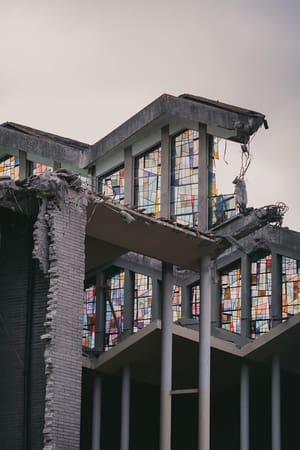
Making Dust is an essay film, a portrait of the demolition of Ireland's second largest Catholic Church, the Church of the Annunciation in Finglas West, Dublin. Understanding this moment as a 'rupture', the film maps an essay by architectural historian Ellen Rowley on to documentation of the building's dismantling. Featuring oral interviews recorded at the site of the demolition and in a nearby hairdressers, the film invites viewers to pause and reflect on this ending alongside the community of the building. The film is informed by Ultimology, and invites its audience to think about the life cycles of buildings and materials, how we mourn, what is sacred, how we gather, what we value and issues of sustainability in architecture.
Pianeta Rota
The geometry of circles and ellipses is explored using the Roman Colosseum as an example. Using the Pantheon as another practical example, this program explores the concepts of central and intercepted angles, arc segments and chords. The Etude du Cinéma de l’Ecole de Barcelona (a short-lived group that appeared in Spain in the 1960s) offers the opportunity to consider the distrust of the avant-gardes with regard to narrative. The lacunar narration whose principle the School of Barcelona adopts goes against the traditional narrative and its quest for coherence and continuity. She invites the viewer to make the disconcerting experience of unbinding and emptiness. Such an approach involves an ethical posture. The Barcelona School follows in the footsteps of a modernity that intends to move away from an alienating authoritarian discourse and claims to make the spectator a partner in creation.
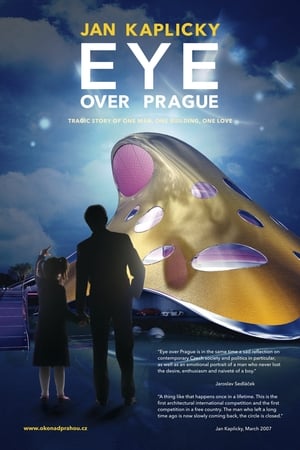
A personal and political biography of the Octopus, or the Prague National Library project, but also a biography of the last years of the life of the author of this design, Jan Kaplický, who wrote in his diary in 1998: to win the competition and have one love. With this entry, read by Eliška Kaplicky at the beginning of the film, it is as if the world-class Czech architect wrote not only the "script" for the final decade of his life, but also for a film that follows the dramatic social story of creative imagination and the intimate relationship between a man and a woman.
La Ricerca della Forma
This J.G. Ballard documentary assembles decades of interviews and archival material to paint a striking portrait of one of the most imaginative and provocative writers of the 20th century.
A comprehensive view of the importance, scope, challenges and achievements of architectural work in the Dominican Republic.
The documentary rebuilds the life of the Brazilian architect João Batista Vilanova Artigas. His relatives, friends, students and six of his major works tell the history of this iconic Latin-American modernist.
Heralded as a palace among minor and major league baseball stadiums, Silver Stadium set a standard of excellence from opening day. From May 1929 through the 1990s Silver Stadium served as home to Rochester's historic baseball team, The Rochester Red Wings, as well as many other sporting teams. When not being used as a baseball stadium, the space served as center stage for a variety of traveling acts. Hear from the people closest to the history of this magnificent facility as they take you on a journey through The Memories of Silver.
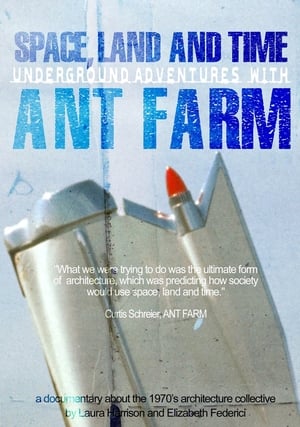
"What we were trying to do was the ultimate form of architecture, which was predicting how society would use space, land and time." Curtis Schreier, ANT FARM Space, Land and Time: Underground Adventures with Ant Farm is the first film to consider the work of the renegade 1970s art/architecture collective Ant Farm, best known for its iconic land-art piece Cadillac Ranch. Radical architects, video pioneers, and mordantly funny cultural commentators, the Ant Farmers created a body of deeply subversive multidisciplinary work that questioned the boundaries of architecture and everything else in the process. Incorporating breathtaking archival video, new footage shot over ten years and animation based on zany period sketches, this film is about the joy of creation in a time when there were no limits. —Beth Federici
GOFF explores the life of architect Bruce Goff, one of the most innovative yet forgotten American architects of the 20th century, and the path that lead to the destruction and restoration of his memory and dwellings.
A documentary film conceived as a virtual dialogue and musical journey in four acts, which investigates the responsibility of architects in building the society of tomorrow.
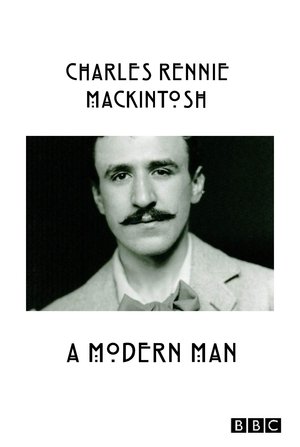
Charles Rennie Mackintosh, architect, designer and artist is celebrated around the world as one of the most significant talents to have emerged in the period from the mid 1890s to the late 1920s. He was one of the greatest, most original talents of this time and has been judged a precursor of firstly the modernist style and subsequently of the Art Deco movement. His legacy lives on all around us in his instantly recognisable style. A MODERN MAN takes a critical look at Mackintosh’s life and artistic career and the importance of the friends and patrons who provided him with regular work when it mattered most.
The film examines Mackintosh's iconic buildings, notably the Glasgow School of Art. Interwoven with his architecture, design and watercolours is the personal story of Mackintosh. Little known at home, his work found favour on the continent. In later years he struggled for work, and came to endure real poverty, but continued to create remarkable pieces of art.
Valérie Jouve is a weel-known photographer, and Grand Littoral is her first film. Out the outskirts of Marseille, in a landscape criss-crossed by motorways, railways and srubland paths, some figures that seem to be from her famous photos passby and bump into each other. They act as our guides in a tour without beginning or end. How do you look at a place without taking possession of it? How do you describe characters without confining them within a given plot? How do you make the transition from still shots to moving pictures? this brief, musical film leaves us asking these and other unresolved questions.
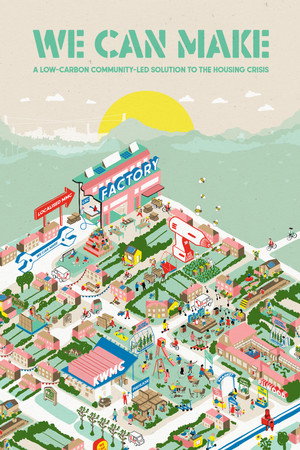
We are in a housing crisis. We urgently need new ideas. Step forward… We Can Make. We are taken to Knowle West, South Bristol, a 100-year-old council-built estate and one of the most deprived areas in Europe. The spirit in the neighbourhood is unbroken though and this community are taking a different route to affordable housing.
The Sound of Microclimates reveals the sights and sounds of a series of unusual weather patterns in the Paris of today. Here, architecture has become interwoven with the natural processes of the geographical landscape. Set within the un-noticed moments in time, extreme microclimates are presented as the future in city accessories, revealing the unseen urban terrains of tomorrow. Like the temporary staged events at an World Expo these weather patterns hi-light public spaces and architecture within the city of Paris. They exist as a series of weather observations that animate the evolution of the inanimate urban condition. Each microclimatic intervention has its own audible frequencies, where the sound from each environment animates the movement and reveals each sites unique narrative.
With the participation of famed architects such as Frank Gehry, Daniel Libeskind and Zaha Hadid, Peter Eisenman: Making Architecture Move provides an intimate look into the work of the daring and controversial creator. Filmed in the U.S. and Germany, Eisenman takes the viewer through several of his buildings, including the Wexner Center in Columbus, Ohio, while explaining his upcoming projects such as the Rebstockpark community in Frankfurt and the Max Reinhardt monument in Berlin. His predecessors and contemporaries offer praise and commentary on Eisenman's complex body of work including their own thoughts and theories surrounding his unique style.
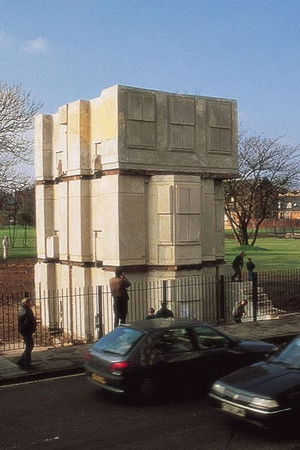
Rachel Whiteread’s cast of a Victorian terraced house in London’s East End was hailed as one of the greatest public sculptures by an English artist in the twentieth century. Completed in autumn of 1993 and demolished in January 1994, House attracted tens of thousands of visitors and generated impassioned debate, in the local streets, the national press and in the House of Commons.