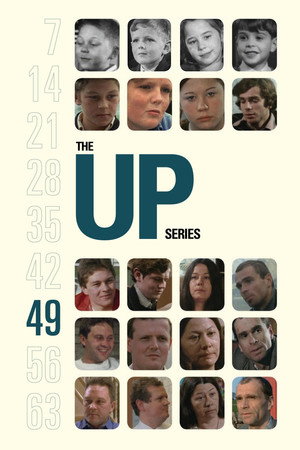
49 Up is the seventh film in a series of landmark documentaries that began 42 years ago when UK-based Granada's World in Action team, inspired by the Jesuit maxim "Give me the child until he is seven and I will give you the man," interviewed a diverse group of seven-year-old children from all over England, asking them about their lives and their dreams for the future. Michael Apted, a researcher for the original film, has returned to interview the "children" every seven years since, at ages 14, 21, 28, 35, 42 and now again at age 49.In this latest chapter, more life-changing decisions are revealed, more shocking announcements made and more of the original group take part than ever before, speaking out on a variety of subjects including love, marriage, career, class and prejudice.
Tell Them We Were Here is an inspirational feature-length documentary about eight artists who show us why art is vital to a healthy society and reminds us that we are stronger together.
How could a German Wehrmacht soldier become a celebrated soccer idol of the Britons in the post-war period? The documentary by Radio Bremen shows the moving life story of the soccer star of the 1950s in a torn Europe and how an enemy became a friend. With his legendary appearance in the English Cup Final 1956, in which he played until the end despite a broken neck, Bert Trautmann set up a memorial for himself in the history of sport. Already in the same year, he is chosen as England’s footballer of the year, and by his club Manchester City even as best player of all times. Bernhard “Bert” Trautmann is one of the most popular and best-known soccer players in England.
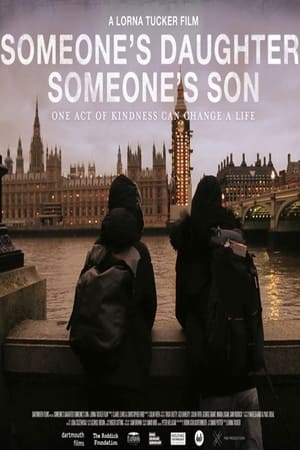
Now a successful filmmaker, Lorna Tucker was once a teenage runaway sleeping rough on the streets of London. For this frank, forceful and inspiring documentary, she returns to her former haunts and speaks to current and former homeless people about why, twenty-five years later, record numbers of people are still reduced to living on Britain's streets.
A cinematic portrait of the homeless population who live permanently in the underground tunnels of New York City.
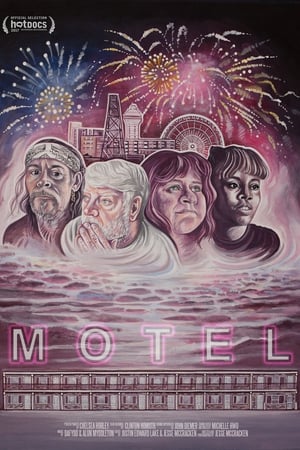
Homelessness in the United States takes many forms. For Elizabeth Herrera, David Lima and their four children, housing instability has meant moving between unsafe apartments, motels, relatives’ couches, shelters, the streets and their car. After 15 years of this uncertainty, the family moved into their first stable housing — an apartment in the San Francisco Bay Area — in the midst of the coronavirus pandemic.
For five years, Stephen McCoy documented street life in Boston. This is what he captured.
Beginning at the industrial revolution of the ‘great north’, Jenn Nkiru draws lines between peoples, cities, countries, buildings, movements, bodies and spaces(s) using a mixture of archive materials and new footage. There is little stillness as we are pushed and pulled through Black histories and communities across the city of Manchester and beyond. Nkiru has termed this filmmaking process “cosmic archeology”, and it is grounded in Afro-surrealism, experimental film and the Black arts movement.
Max Ramsey, an advocate for those experiencing poverty, uses what he has gone through to serve the impoverished community of Milwaukee despite internal struggles and disapproval from the city.
Examines the intergenerational impact of addiction by chronicling the love, labor, loss, and uncertainty of one woman’s struggle to live a life of sobriety. Weaving together moments of glee, fulfillment, acceptance, sorrow, and disappointment, this documentary takes an intimate look at the bonds that hold one family together and a disease that threatens to tear them apart.
A documentary made for television that looks back on the development and rapid rise of Oasis from being a band practicing nightly in the Boardwalk to one the biggest British bands of the last thirty years. Building from the formation of the band (with Liam apparently just fed up waiting for other bands to release records and decides to do something himself), the film uses contributions from key people really well to tell the story in an engaging way.
Since the fall of the Iron Curtain an estimated four million children have found themselves living on the streets in the former countries of the Soviet Union. In the streets of Moscow alone there are over 30,000 surviving in this manner at the present time. The makers of the documentary film concentrated on a community of homeless children living hand to mouth in the Moscow train station Leningradsky. Eight-year-old Sasha, eleven-year-old Kristina, thirteen-year-old Misha and ten-year-old Andrej all dream of living in a communal home. They spend winter nights trying to stay warm by huddling together on hot water pipes and most of their days are spent begging. Andrej has found himself here because of disagreements with his family. Kristina was driven into this way of life by the hatred of her stepmother and twelve-year-old Roma by the regular beatings he received from his constantly drunk father. "When it is worst, we try to make money for food by prostitution," admits ...
This documentary about teenagers living on the streets in Seattle began as a magazine article. The film follows nine teenagers who discuss how they live by panhandling, prostitution, and petty theft.
Carol Morley returns to Manchester, where in the early 1980s, five years of her life were lost in an alcoholic blur. The Alcohol Years is a poetic retrieval of that time, in which rediscovered friends and acquaintances recount tales of her drunken and promiscuous behavior. In Morley’s search for her lost self, conflicting memories and viewpoints weave in and out, revealing a portrait of the city, its pop culture, and the people who lived it.
SFRJ is officially a place where everyone have a job and a house. The story follows hard labored workers who can't find a job, who bathe in public bathrooms and sleep in homeless centers.
Director invites six homeless men to his flat for a few days (surprising his wife). He asks officials and people on the street if someone can help them, this being SFRJ, a state officially without those left on their own.
An inspiring feature documentary film about overcoming homelessness and addiction in the City of Los Angeles.
A documentary about homeless people living in Switzerland.
Following director Rotimi Rainwater, a former homeless youth, as he travels the country to shine a light on the epidemic of youth homelessness in America.
Tough kids from tough backgrounds living dangerous lives - these are the young people of the Oasis, a grimy brick youth refuge in inner-city Sydney. No story is too horrific, no circumstance too dire, no kid too damaged for its tireless director, Captain Paul Moulds. Father figure, counselor, saviour and an orphan himself, Paul is nothing short of a legend amongst those who stumble in at breaking point with nowhere left to go. This raw observational documentary filmed over two years captures Paul's daily battle to save these lost children of the so-called "Lucky Country".