Traquer l'invisible - Nos chercheurs face à la menace mondiale des virus et des bactéries
Short public information film showing housewives' efficient and hygienic methods of food storage.
Through revealing interviews with experts and victims' families, this gripping documentary examines the problem of deadly foodborne illness in the US.
Food Safety Food Handler Training Video from the city of Irving, Texas
To bude pochoutka
Sales of organic products have increased tenfold in 20 years. In 2020, the market will have exceeded 13 billion euros in sales. The heavyweights of the food industry are surfing on this consumer craze for healthy food by offering more and more "green" products. But organic does not necessarily mean nutritionally balanced.
This eye-opening documentary follows six couples with unexplained infertility as they lower their exposure to plastics in hopes it helps them conceive.
Intoxications alimentaires, menaces dans nos assiettes
Discusses safe food handling for mothers-to-be. Topics covered include shopping, food storage, food preparation, cooking, serving food on the go, leftovers/reheating, safe bottle-feeding, diaper changing, etc.
Produced by a division of social services, the film follows a country girl's journey to learn more about hygiene and health after she's rejected from by her boyfriend who thinks her uncultivated.
From McDonald's Australia, this orientation training video presented by national training manager John Bouropoulos walks new employees through how to get through this part of the shift rush.
The film "Sanitation: Why All The Fuss?" emphasizes the critical importance of sanitation in food handling for public health. It explains how bacteria, which can multiply rapidly and cause illness, are often transferred by people, pests, and contaminated tools. To prevent foodborne illnesses, food handlers must adhere to strict hygiene practices, including frequent handwashing, maintaining proper food temperatures, and ensuring cleanliness in food preparation areas. The film highlights that while heating food kills bacteria, it does not eliminate toxins that may have already formed, making prompt refrigeration essential.
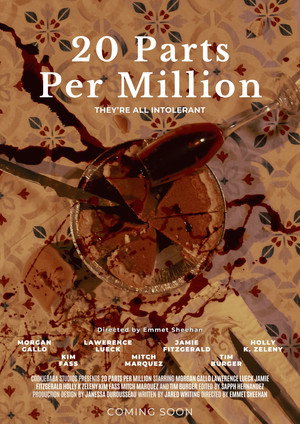
An emerging adult with Celiac disease hosts Thanksgiving with her intolerant family while trying to attain the funds that would cover her fiancé's life-saving medical treatment.
Everybody's Business is a light-hearted satire on Singapore and Singaporeans from different walks of life. When Singapore is hit with a widespread bout of food poisoning – with at least fifty victims – everyone is sent into a tizzy. How on earth could something like this happen in Singapore? And who’s responsible?
Produced by the International Dairy-Deli Association, this food safety training video centers on Alice, a new employee who learns how different areas of a deli operates and the importance of maintaining a clean environment to avoid "the Danger Zone" with the help of her co-worker Cathy and well-dressed teleporting man who goes by many names.
For the past forty years, Igor Pasternak has pursued a lighter-than-air vision: to build gigantic airships that haul cargo to otherwise inaccessible parts of the planet. In high school, in Ukraine, Pasternak formed an airship club; at Lviv National University, where he studied civil engineering, he established an airship-design bureau. Eventually, he settled in southern California and started Aeros, which builds blimps for surveillance and other purposes. His prototype cargo airship, the two-hundred-and-sixty-foot-long Dragon Dream, was destroyed in 2013 when its hangar collapsed on it. Unfazed, Pasternak now aims to produce a fleet of “Aeroscraft” cargo airships, the largest of which will be more than nine hundred feet long and able to carry five hundred tons. Pasternak spoke recently with the director and producer Gabe Polsky. Polsky’s documentary, “Red Army,” played at the 2014 Cannes, Telluride, Toronto, and New York Film Festivals, and was released in theatres in 2015.
Starting with a long and lyrical overture, evoking the origins of the Olympic Games in ancient Greece, Riefenstahl covers twenty-one athletic events in the first half of this two-part love letter to the human body and spirit, culminating with the marathon, where Jesse Owens became the first track and field athlete to win four gold medals in a single Olympics.
SWITCH - Camille Juban a life commitment
The Tisza has meandered through the Great Plain for thousands of years. Ever since man first appeared on its banks, he has been trying to put the blonde river at his service. He has drunk its water, irrigated it, cut it up and levelled it. And 50 years ago he stopped it to turn it into a big reservoir. Little did he know then that his work would conjure up the world of the ancient Tisza. Thanks to the river’s waters, a unique ecosystem has been created. Man built it, nature built it. Thus was created a man-made paradise: the Tisza Lake. The narrator of the film, Dimitry Ljasuk, takes the viewer by the hand and shows, through all 4 seasons, what this special place has become over the decades. Millions of special birds and fish have settled here, and the dense vegetation has painted the banks of the blonde river green. Today, wild meanders, black-water inland lakes, labyrinths of reeds and thousands of islands are reminiscent of the ancient Tisza.
Part two of Leni Riefenstahl's monumental examination of the 1938 Olympic Games, the cameras leave the main stadium and venture into the many halls and fields deployed for such sports as fencing, polo, cycling, and the modern pentathlon, which was won by American Glenn Morris.