Ivan Melnychuk documents the changes in Kyiv, focusing on the ruins of buildings constructed from the late 60s for workers. As an architect, he observes the ‘improvements’ of public spaces, highlighting small gestures common in Ukraine. These actions, driven by pragmatism, involve occupying spaces without considering broader effects, reflecting a persistent situation where public spaces are subtly manipulated.
In this documentary, wealthy entrepreneur Bryan Johnson puts his body and fortune on the line to defy aging and extend his life beyond all known limits.
An immersive dive into the heart of the discomfort felt by anyone struggling to sleep.
Two filmmakers juxtapose field recordings and documented moving images as an attempt to reconcile with their place in their desensitized semi-urban hometown in India.
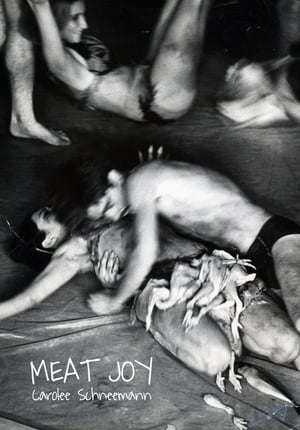
"Meat Joy is an erotic rite — excessive, indulgent, a celebration of flesh as material: raw fish, chicken, sausages, wet paint, transparent plastic, ropes, brushes, paper scrap. Its propulsion is towards the ecstatic — shifting and turning among tenderness, wildness, precision, abandon; qualities that could at any moment be sensual, comic, joyous, repellent. Physical equivalences are enacted as a psychic imagistic stream, in which the layered elements mesh and gain intensity by the energy complement of the audience. The original performances became notorious and introduced a vision of the 'sacred erotic.' This video was converted from original film footage of three 1964 performances of Meat Joy at its first staged performance at the Festival de la Libre Expression, Paris, Dennison Hall, London, and Judson Church, New York City."
A train moves through winter as a superimposed image of the same route in spring gradually emerges. Both moments coexist within a single frame, revealing two seasons happening at once.
An audiovisual essay constructed from Super 8 footage filmed during camera tests for the short film ‘La Trampa’. Through gestures, light, and silences, it reflects on what the image reveals and what it leaves unsaid.
In an attempt to represent reality, the boundary between life and art blurs between fragmentary images of someone and the praxis of an essay film.
Omniac
Two friends await in the airport for a third friend to arrive. As the passangers come by, pictures not taken accompany a conversation between the two friends.
Filmed in Berlin, July 1990. Images of workers taking down the wall and street peddlers selling pieces of it to make a living.
How do we influence the world around us? A fluid analysis tool ordinarily used in the laboratory offers new interpretations of human interaction and provides surprising insights about our place in the world.
An investigation about human intervention in nature, from the subjective point of view of the camera, the environment and its transformation are observed.
A contemplative portrait of a liminal space, where anonymous inscriptions transform a place of transit into a quiet archive of memory
It is a documentary about mostly inner-city birds. It is meant to examine their lives in a more metropolitan context as they become increasingly tangled in our everyday lives.
A quick view of three remarkable organic gardens: Le Tomple, Le jardin du Mas d’Abri in the department of Gard and Le jardin des Sambucs in the department of Hérault. The film goes over their general layout along pathways amongst the vegetation, ponds and people or animals that happen to be there at the time.
The Tiger God project originated during the artist’s residency at Cien Art Village in Hualien in 2021, inspired by a Sikawasay (Amis priest) who said a concrete tiger carried a soul. The work explores encounters between Han folk beliefs and Amis spiritual traditions, reflecting on suppressed indigenous histories in eastern Taiwan under colonial and religious forces. Nighttime fireworks symbolize external impacts on the land, linking concrete animals, mining, and colonial imagination. The ritual opera returns the footage to the land and gods, weaving ritual, research, and reflection into a narrative about silent objects and memory.
A long-form 'artist moving image' documentary film that sits in a fictitious conceit that begins in a distant future, inspired by Russell Hoban’s cult novel ‘Riddley Walker’. A medley of documentary, fantasy, song and dance: shot on a tapestry of celluloid film stocks and developed by hand.
In the rural desert of Bolivia, where the most important presence is the wind moving between papa flowers and animals, the people who harvest the land, those who built the ancient artifacts and sacred objects and the musicians who play moseñada – songs linked to the first products of the harvest – on the streets of the city have one point in common: labor. With a successful inclusion of stories of enchanted lakes, legends that pass from mouth to mouth – or from orality to audiovisual, in this case – and give a fantastic aura to those lands, Luciana Decker Orozco not only manages to capture life without oscillations . field, but resorts to the incessant movement of images and sound accompaniment to define a sensory and transcendental experience for the viewer.
What are they? What do they seek? When all the lights go out, they will wander. And you will never see them.